







Could your "normal" ferritin actually be too low?
November 3, 2026
TL;DR
- Ferritin is the protein that stores iron, and the amount in your blood is the main test of how much iron you have in reserve.
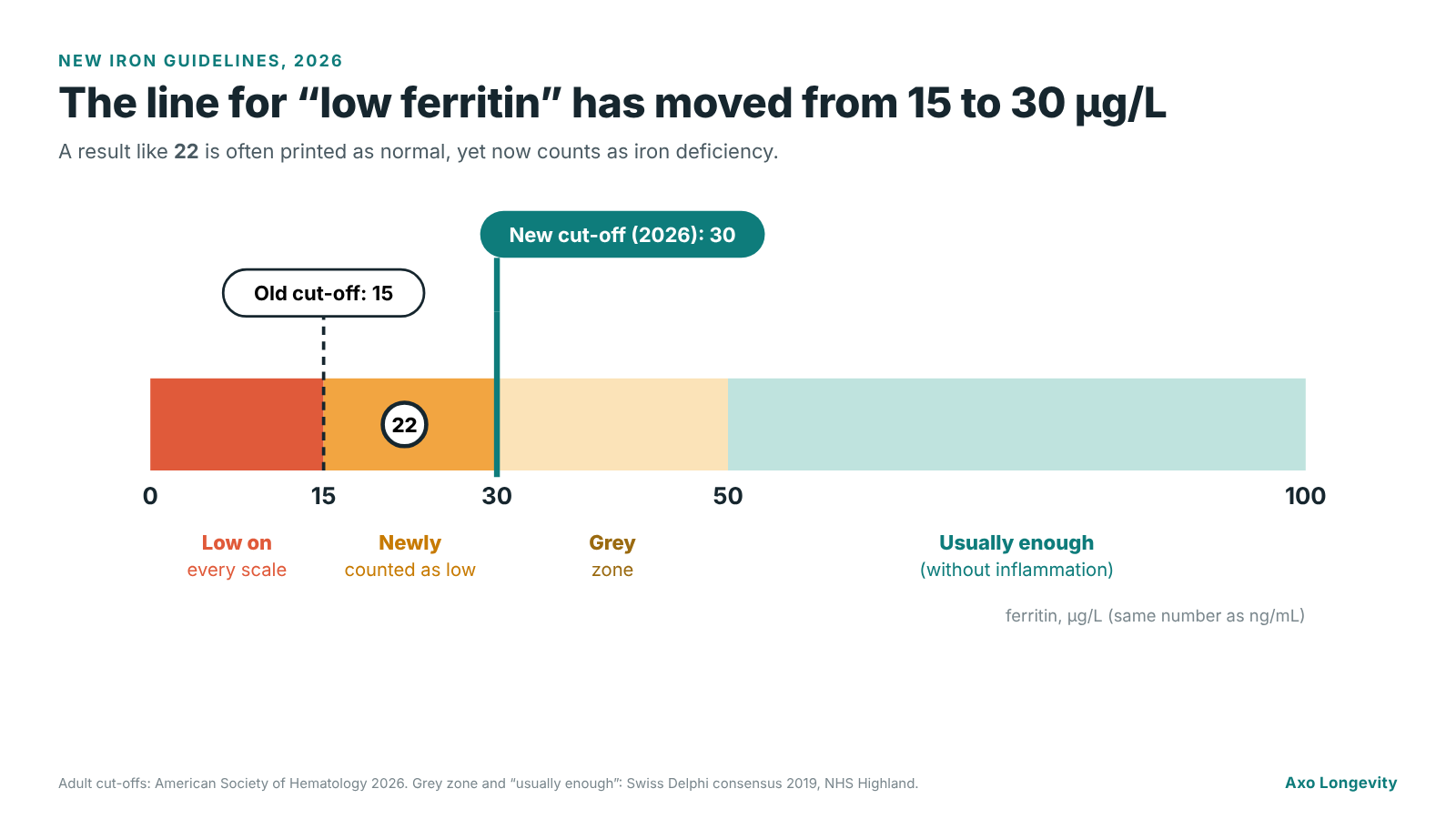
- Guidance published in 2026 by the American Society of Hematology raised the adult cut-off for iron deficiency from 15 to 30 µg/L (the same number as 30 ng/mL).
- Many lab ranges still start well below 30, partly because older reference ranges were built from groups that included people already short of iron.
- In a Swiss study of 255,351 adults, using 30 instead of 15 as the cut-off nearly tripled how often iron deficiency was found.
- A ferritin level of 30 or lower is worth discussing with your doctor, read alongside haemoglobin, transferrin saturation and CRP, rather than a reason to start iron on your own.
You get your blood results back, the ferritin line says 22 µg/L, and it is not flagged. The range printed next to it starts at 13 or 15, so 22 looks fine. Yet you are tired, and you keep reading that a ferritin level of 30 is low.
That gap between the report and the research is real, and in 2026 it became official in one large guideline. This guide explains what ferritin measures, why the cut-off moved, what labs and guidelines across Europe use, and what a result between 15 and 50 actually means for you.
What is ferritin?
Ferritin is a protein that stores iron inside your cells. A small amount circulates in the blood, and that amount rises and falls with the size of your iron reserve. A ferritin blood test is therefore the simplest way to see how much iron you have put away for later.
Think of your iron as food in a kitchen. Ferritin is the pantry: the stock you keep for later. Haemoglobin, the iron-rich protein inside red blood cells that carries oxygen, is the food already on the plates. You can keep the plates full while the pantry runs down, and a standard blood count only looks at the plates.
Ferritin does not need fasting, so you can have it measured at any time of day. Our guide to which blood tests need fasting covers the ones that do.
What changed in the new iron guidelines?
The American Society of Hematology now says an adult with a ferritin of 30 µg/L or lower has iron deficiency, up from the long-used 15. The 2026 guideline, summarised in JAMA in October 2026, applies to adults in general, including people who menstruate and pregnant women.
The other thresholds moved in the same direction:
- Adults: 30 µg/L or lower, up from 15
- Young children (9 months to 4 years): 20 µg/L or lower, up from 12
- Adults with inflammation (for example cancer, inflammatory bowel disease or infection): ferritin under 100 µg/L, or transferrin saturation under 20%
The panel's reason is simple. Iron deficiency is one of the most common nutrient problems in the world, affecting an estimated 2 billion people, and in high-risk groups up to 70% of cases were being missed. Guidance on treatment is due to follow.
This is an American guideline, so it does not change what your local lab prints overnight. It does show where the evidence now points.
How is ferritin different from haemoglobin?
Ferritin measures stored iron; haemoglobin measures the iron already at work in your red blood cells. When iron runs short, the stores empty first and haemoglobin only falls once they are nearly gone. That is why ferritin can be low while your full blood count looks completely normal.
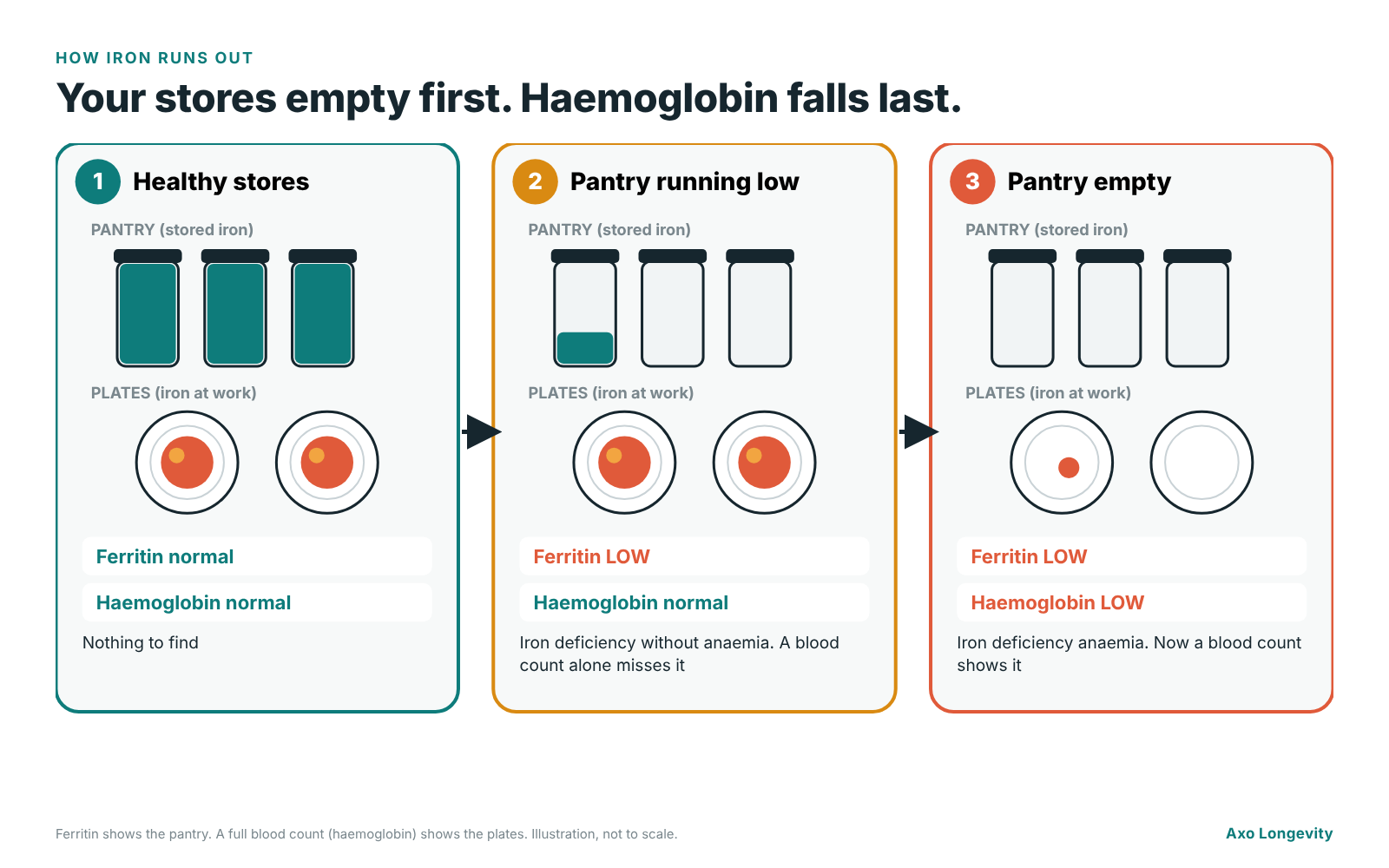
As the graphic shows, iron deficiency is a slow slide rather than a switch. At first the pantry is getting low while every plate is still full: ferritin falls, haemoglobin stays normal, and a standard blood count looks fine. That middle stage is iron deficiency without anaemia. Only when the pantry is almost bare do the plates start to empty, and that is when a blood count shows anaemia.
Why was the old ferritin cut-off so low?
Because many reference ranges were built from groups that already included people short of iron. A lab range usually describes the middle 95% of a "healthy" group, so if that group contains plenty of people with empty stores, the bottom of the range ends up very low.
A 2024 review traced where ferritin ranges come from. Across 37 studies of the general population, the median lower limit was 8 µg/L for women and 25 µg/L for men. Almost half of the studies (49%) did not screen out people at risk of iron deficiency before setting the range, and healthy-adult ranges consistently put the lower limit below 30.
So a report can mark 18 µg/L as "normal" simply because 18 is common, not because it is enough. That is one reason Axo Longevity compares results to optimal ranges, not only standard ranges: a value can sit inside the printed range and still be worth a closer look.
What ferritin level counts as iron deficiency in Europe?
There is no single European number, and that is the honest answer. Most guidance now agrees that a ferritin under 30 µg/L points to iron deficiency in adults without inflammation, while the cut-off printed on lab reports often sits lower. Units do not change the picture: ng/mL and µg/L are the same number.
The guidance you may come across includes:
- WHO (2020): under 15 µg/L in adults, or under 70 µg/L with infection or inflammation. This is the oldest and lowest of the current numbers.
- Swiss Delphi consensus (2019): a cut-off of 30 µg/L gives good accuracy for iron deficiency without anaemia; 30 to 50 µg/L with a transferrin saturation under 20% can still fit; under 100 µg/L is appropriate with inflammation.
- Specialist European guidance: for inflammatory bowel disease, under 30 µg/L without inflammation; for heart failure, under 100 µg/L, or 100 to 299 µg/L with a transferrin saturation under 20%. A 2023 review found guidelines still differ, with no single agreed cut-off.
- A UK example: NHS Highland guidance treats under 30 µg/L as iron depletion, says 30 to 50 µg/L can still fit (especially in older people or with inflammation), and above 50 µg/L excludes iron deficiency when there is no inflammation.
How accurate is a ferritin cut-off of 30?
Much more accurate than 15 or 12. In a study of people with anaemia whose iron status was confirmed by bone marrow or by their response to iron, a ferritin of 12 µg/L or lower caught only 25% of those who were iron deficient. A cut-off of 30 µg/L caught 92%, and still correctly cleared 98% of those who were not.
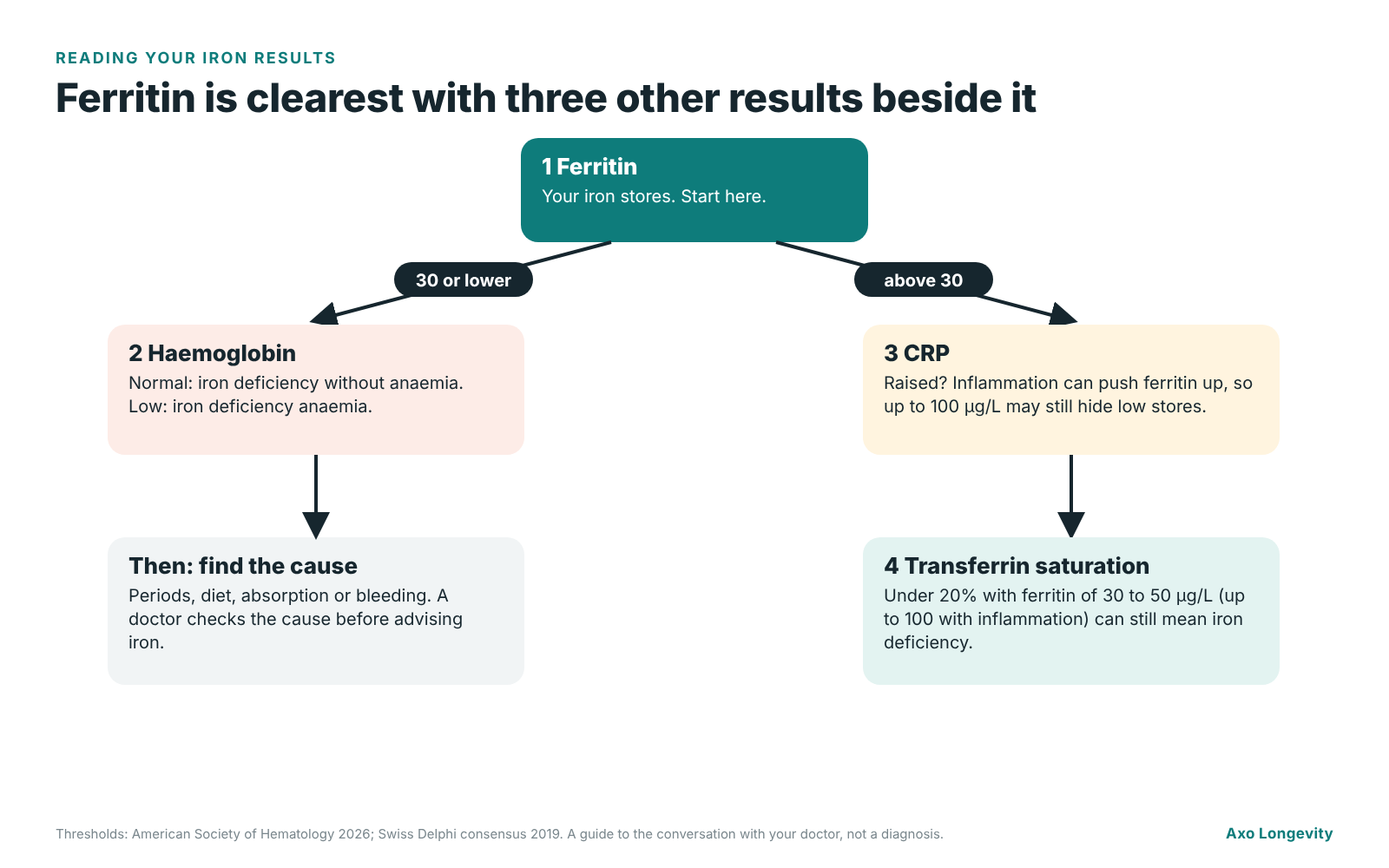
As the graphic shows, ferritin is most reliable when it is read with three companions. Haemoglobin shows whether the plates have started to empty. Transferrin saturation shows how much iron is actually in transit, and is useful when ferritin sits in the grey zone. CRP shows whether inflammation is pushing ferritin up and hiding a low reserve.
Why can two people with a similar ferritin get different answers?
Because ferritin is only half of the story. The same number means different things depending on haemoglobin, inflammation and what was happening in your body the week you were tested.
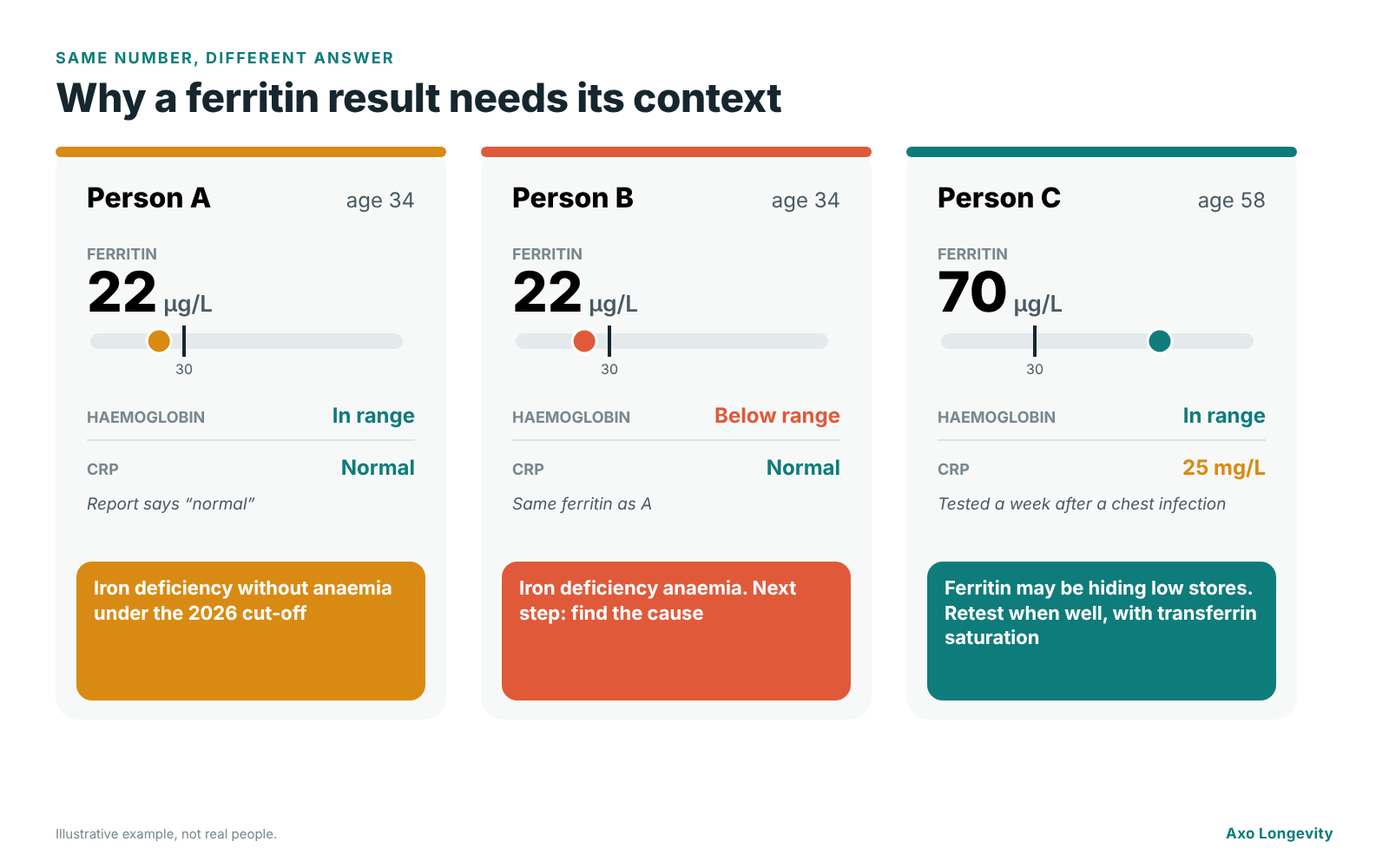
Take three people (an illustrative example, not real people). Person A is 34, with a ferritin of 22 µg/L and a haemoglobin inside the lab's range. The report says "normal", but under the 2026 cut-off Person A has iron deficiency without anaemia: the pantry is low and the plates are still full. Person B is also 34 with a ferritin of 22 µg/L, but haemoglobin has dropped below the range, which makes it iron deficiency anaemia. The next step is finding the cause.
Person C is 58, and a ferritin of 70 µg/L looks comfortable until you notice when the blood was taken: a week after a chest infection, with a CRP of 25 mg/L. Ferritin rises with inflammation, so 70 may be hiding a much lower reserve. Retesting once the infection has cleared, with transferrin saturation, gives the real answer.
Before you test: if you have had a cold, flu or any infection in the last few weeks, mention it or move the test, because inflammation pushes ferritin up. Ask for transferrin saturation and CRP alongside ferritin, and retest in the same lab, because ferritin thresholds vary from lab to lab.
Which lab tests should you ask for to check your iron?
Ask for a small iron panel rather than ferritin on its own. Ferritin, a full blood count, transferrin saturation and CRP together show how full your stores are, whether anaemia has started, how much iron is moving in your blood and whether inflammation is masking a low result.
Checking your iron for the first time? These four lab tests give the full picture:
- Ferritin: your iron stores, read against the 30 µg/L cut-off rather than only the printed range
- Full blood count: haemoglobin, which shows whether the plates have started to empty
- Transferrin saturation: iron in transit, most useful when ferritin sits between 30 and 50 µg/L
- CRP: inflammation, which can push ferritin up and hide low stores
Already had a low or borderline result? Retest the same four, in the same lab, once any infection has cleared, so the numbers can be compared. If ferritin was between 30 and 50 µg/L, a transferrin saturation under 20% is the result that can still point to iron deficiency.
None of these replaces the tests your doctor arranges to find the cause of low iron. They give you and your doctor a clearer starting point.
Axo Longevity Care membership is built around the same before and after pattern: a baseline of 100+ lab tests, then a follow-up around six months later that repeats 50+ of them, with your results compared to optimal ranges and a personalised plan. Availability varies by country, and some lab tests are not offered in every market, so check which of the tests above are included where you live.
→ Check your iron with Axo Longevity Care
What did the Swiss primary care study find?
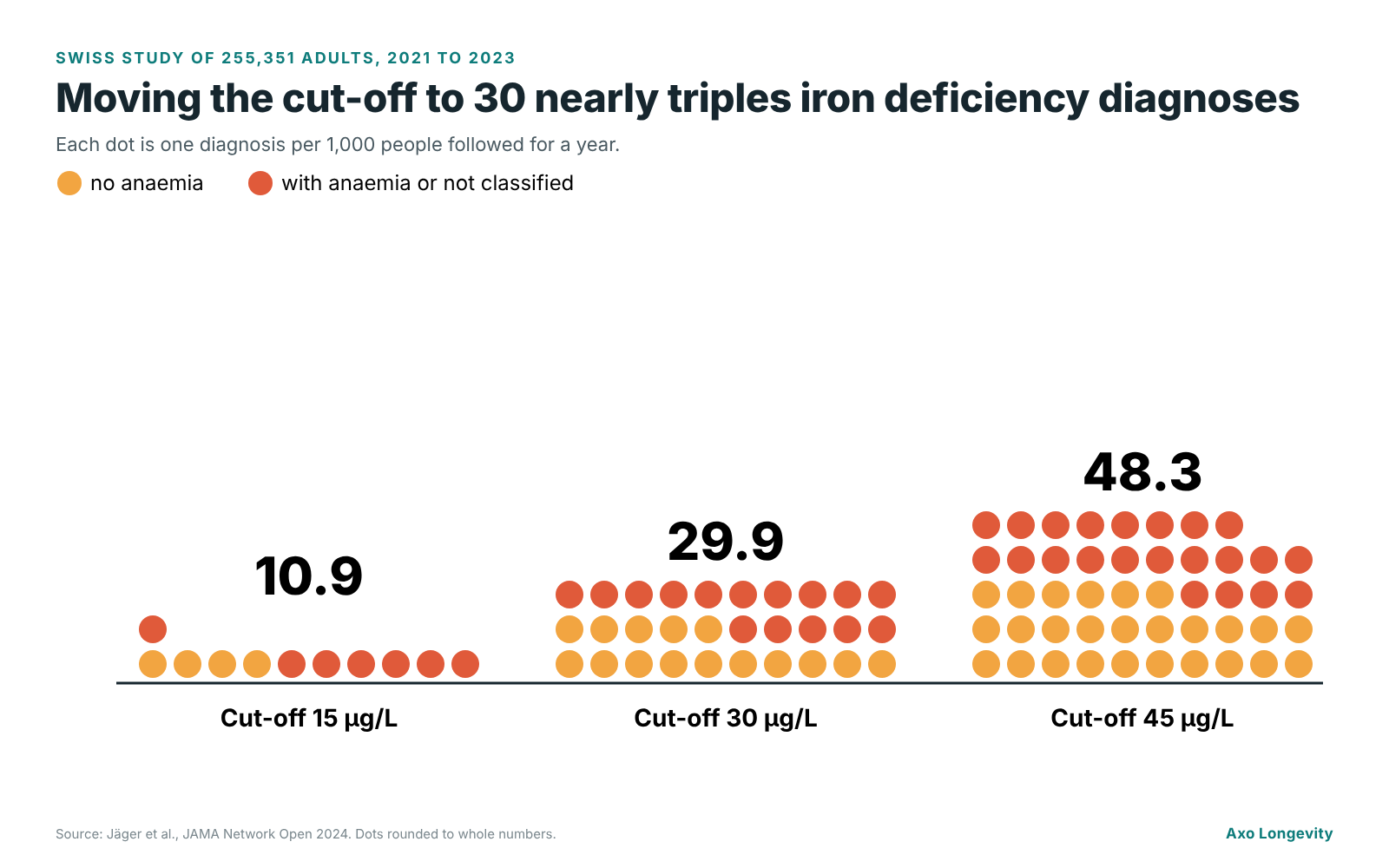
A Swiss study looked at what happens in everyday practice when the cut-off changes. It followed 255,351 adults seen by family doctors in Switzerland between 2021 and 2023, with a median age of 52, just over half of them women, and counted how often iron deficiency would be diagnosed at different ferritin thresholds.
- At a cut-off of 15 µg/L, iron deficiency was found 10.9 times per 1,000 people per year
- At 30 µg/L, that rose to 29.9, nearly three times as many
- At 45 µg/L, it reached 48.3
- Most of the extra cases had no anaemia: iron deficiency without anaemia rose from 4.1 to 14.6 per 1,000 people per year between the 15 and 30 cut-offs
- People with fatigue were about twice as likely to have their ferritin tested
The researchers concluded that the choice of cut-off changes who gets diagnosed far more than most people realise, and called for agreed criteria.
How worried should you be about a ferritin between 15 and 30?
Enough to look into, calmly. A ferritin between 15 and 30 µg/L is a signal that your iron stores are low, not a diagnosis of anything serious. The more useful question is why the stores are low.
As the graphic shows, moving the cut-off from 15 to 30 adds about 19 diagnoses for every 1,000 people followed for a year, and most of them are people with a normal blood count. Their stores are low, but their haemoglobin has not changed yet. The common causes are heavy periods, pregnancy, a diet low in iron, and blood loss from the stomach or bowel, which can come from anti-inflammatory painkillers, ulcers, inflammation or, less commonly, cancer.
See your doctor if you have a low ferritin together with any of these:
- tiredness, breathlessness or a pounding heartbeat that does not settle
- heavy periods
- any bleeding you cannot explain, including from your bottom
- difficulty swallowing
What else has research found about low ferritin without anaemia?
That treating it can help, though not with everything. In a trial of 198 women with unexplained tiredness, a ferritin under 50 µg/L and a normal blood count, 12 weeks of iron improved fatigue by 3.5 points more than a placebo on a 40-point scale. It did not change mood, anxiety or quality of life.
That result supports the idea that a low ferritin can matter before anaemia appears. It also shows that not every symptom will be the iron, which is why the cause and the full picture matter more than one number.
Can you raise your ferritin?
Yes, usually, once the cause is clear. Ferritin rises when you take in more iron than you lose, so the first step is working out where it is going: periods, diet, absorption or bleeding. Iron is best started with a doctor, who can check the cause first and retest to see whether stores are refilling.
In practice:
- ask what is behind the low result before you start any supplement
- keep a note of heavy periods, recent blood donation or dietary changes, and mention them
- retest once you have been taking iron for a while, in the same lab, with haemoglobin and transferrin saturation alongside
Your Axo Longevity personalised plan starts from the results that are out of their optimal range, so the changes you make target what matters most for you.
→ Read the lab tests that matter for persistent low energy
How do you track your ferritin over time?
By testing more than once, under the same conditions. A single ferritin result shows your stores on one day; two or three results months apart show whether they are filling, holding or draining. Our guide to the causes of low energy explains why tiredness so often needs more than one test.
Axo Longevity measures 100+ lab tests across 36+ areas of your health, and every result is compared to its optimal range. Around six months later, a follow-up repeats 50+ of those lab tests, so you can see the change for yourself.
→ Your Axo Health Score
→ Results compared to optimal ranges
→ Your personalised plan
→ A follow-up test to track the change
What else do people ask about ferritin and iron deficiency?
Is a ferritin level of 30 low?
Under 2026 American Society of Hematology guidance, a ferritin of 30 µg/L or lower counts as iron deficiency in adults. Many lab ranges still call it normal, so it is worth discussing with your doctor alongside your haemoglobin and transferrin saturation.
Can ferritin be normal and you still be iron deficient?
Yes. Inflammation or infection raises ferritin, so a result up to 100 µg/L can still hide low iron stores. A low transferrin saturation or a raised CRP helps show when that is happening.
Is ferritin in ng/mL the same as µg/L?
Yes. One nanogram per millilitre equals one microgram per litre, so a ferritin of 30 ng/mL is the same as 30 µg/L.
Axo Longevity provides health information, not medical advice. Speak to a healthcare professional about your results.
Where does this information come from?
- Powers, J. M., Lim, M. Y., Achebe, M. O., et al. (2026). American Society of Hematology 2026 guidelines for diagnosis of iron deficiency. Blood Advances. https://doi.org/10.1182/bloodadvances.2025015950
- Richmond, S. (2026, October 23). New guidelines issued for diagnosing iron deficiency. JAMA. https://doi.org/10.1001/jama.2026.20028
- Truong, J., et al. (2024). The origin of ferritin reference intervals: a systematic review. The Lancet Haematology. https://pubmed.ncbi.nlm.nih.gov/38937026/
- World Health Organization. (2020). WHO guideline on use of ferritin concentrations to assess iron status in individuals and populations. https://www.ncbi.nlm.nih.gov/books/NBK569877/
- Nowak, A., et al. (2019). Swiss Delphi study on iron deficiency. Swiss Medical Weekly, 149, w20097. https://boris.unibe.ch/133381/
- Rohr, M., Brandenburg, V., & Brunner-La Rocca, H.-P. (2023). How to diagnose iron deficiency in chronic disease: a review of current methods and potential marker for the outcome. European Journal of Medical Research, 28, 15. https://link.springer.com/article/10.1186/s40001-022-00922-6
- NHS Highland. (2024). Iron deficiency guidelines. https://www.rightdecisions.scot.nhs.uk/tam-treatments-and-medicines-nhs-highland/adult-therapeutic-guidelines/haematology/iron-deficiency-guidelines/
- Mast, A. E., et al. (1998). Clinical utility of the soluble transferrin receptor and comparison with serum ferritin in several populations. Clinical Chemistry. https://pubmed.ncbi.nlm.nih.gov/9550557/
- Jäger, L., et al. (2024). Ferritin cutoffs and diagnosis of iron deficiency in primary care. JAMA Network Open. https://jamanetwork.com/journals/jamanetworkopen/fullarticle/2821953
- Vaucher, P., et al. (2012). Effect of iron supplementation on fatigue in nonanemic menstruating women with low ferritin: a randomized controlled trial. CMAJ, 184(11), 1247–1254. https://doi.org/10.1503/cmaj.110950
- NHS. Iron deficiency anaemia. https://www.nhs.uk/conditions/iron-deficiency-anaemia/
- Royal United Hospitals Bath NHS Foundation Trust. (2025). Ferritin: a guide. https://www.ruh.nhs.uk/pathology/documents/clinical_guidelines/HAEM_Ferritin_a_guide_for_GPs.pdf
2 ways to get started
It's the best fit if you want an affordable entry point to understand your health baseline.
50+ biomarkers (one round)
Basic biomarker analysis
Biological Age and Axo Longevity Health Score
Cancel anytime
approx.
It's the best fit if you want to track trends over time rather than just see a single moment.
100+ biomarkers annually (two rounds)
Sports science protocols
Personalised health blueprint
Continuous tracking
Biological Age and Axo Longevity Health Score
Cancel anytime
approx.
150+ biomarkers annually (two rounds)
Exclusive 1:1 longevity session with Dr. Niko Mihic or Andy Walshe PhD
GlycanAge testing
Comprehensive genome testing
Annual founding member event
approx.