








Everything you need to know about GLP-1: which blood tests should you track?
October 30, 2026
TL;DR
- GLP-1 medicines such as Wegovy, Ozempic and Mounjaro mimic a gut hormone that makes you feel full, and they change several blood test results as well as your weight.
- Many results improve: in the main Wegovy trial, CRP ended 44% lower than with placebo, and blood sugar, blood fats and blood pressure all improved.
- Some need watching: in a 2026 review of more than 480,000 GLP-1 users, 13.6% had low vitamin D after a year, and smaller numbers had low iron or B vitamins.
- Part of the weight lost is muscle and other lean tissue, which makes protein and strength training especially important on a GLP-1.
- A blood test before you start, then a retest during treatment, shows what is improving and what needs attention.
Most people on a GLP-1 track one number: the one on the scales. It is the number that changes fastest and the one everybody asks about. Yet a weekly injection that cuts how much you eat reaches far beyond your weight, and a blood test shows where.
Some of those changes are exactly what you would hope for. Others move in the wrong direction while you feel well and your weight keeps falling. This guide explains how GLP-1 medicines work, which blood results tend to improve, which ones to keep an eye on, and how testing helps you get the most from the medicine.
What is a GLP-1 and how does it work?
A GLP-1 medicine copies a natural hormone your gut releases after you eat. The hormone tells your brain you are full, slows how fast your stomach empties and helps your body handle blood sugar. Semaglutide (Wegovy, Ozempic) works this way, and tirzepatide (Mounjaro) also acts on a second hormone involved in appetite and blood sugar.
Think of it as turning down the appetite dial for your whole body. Smaller portions feel like enough, and snacking loses its pull. That is how the weight comes off. The catch is that the dial does not choose what to cut. Fewer calories in also means less protein, fewer vitamins and less iron in, unless you plan for it.
Your weight shows that you are eating less, but only a blood test shows what eating less is doing to the rest of you.
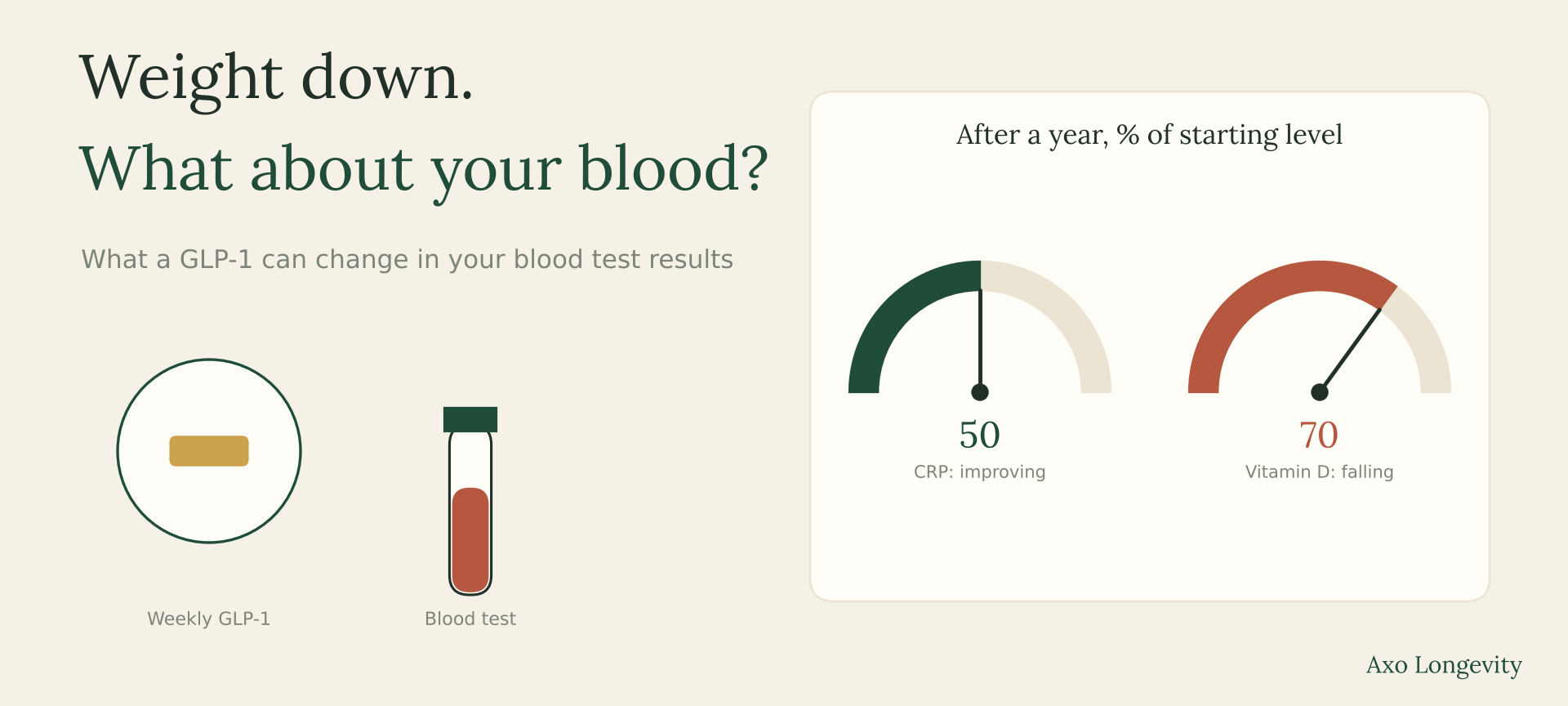
How do GLP-1 medicines affect your blood test results?
GLP-1 medicines change your blood test results in two directions at once. Results linked to weight and metabolism, such as CRP, blood sugar and blood fats, usually improve. Results that depend on what you eat, such as vitamin D, iron and B vitamins, can fall. A single number cannot show both.
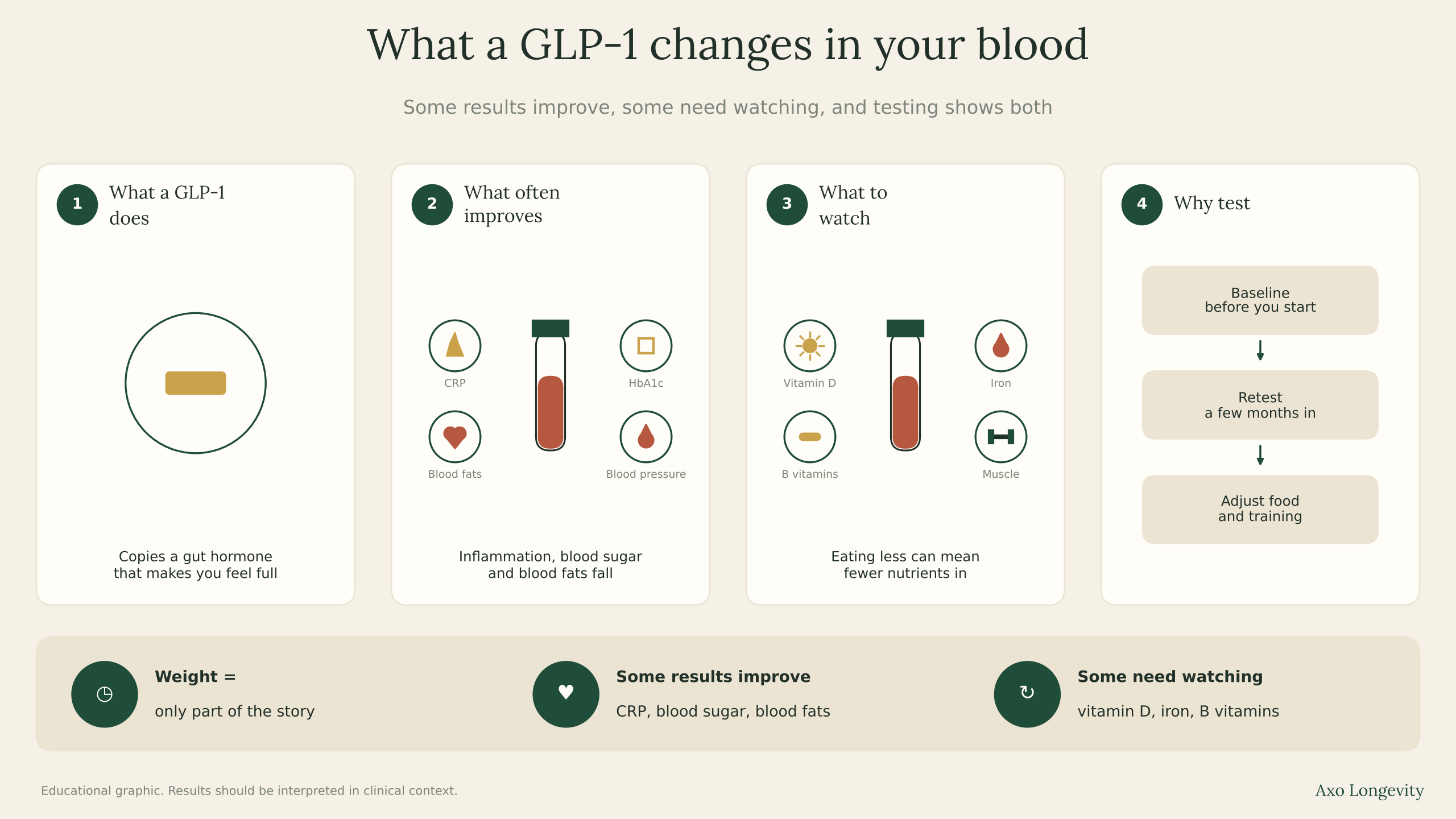
The graphic above sums it up. The first two panels are the reason people start a GLP-1. The third is easy to miss, because nothing about it shows up on the scales. The fourth is how you see all of it: a baseline, a retest and changes based on what the results show.
Which blood results usually improve on a GLP-1?
Inflammation, blood sugar, blood fats and blood pressure usually improve on a GLP-1. In the main Wegovy trial, almost 2,000 adults with overweight or obesity took weekly semaglutide or a placebo for 68 weeks, alongside diet and activity advice. The semaglutide group lost 14.9% of their body weight on average, against 2.4% with placebo.
Their blood changed too. CRP, a blood test for inflammation, ended 44% lower with semaglutide than with placebo. HbA1c, fasting glucose and blood fats improved more than with placebo, and systolic blood pressure fell by about 6 mmHg, against about 1 mmHg with placebo.
These are meaningful changes. CRP, blood sugar and blood fats are all linked to long-term heart and metabolic health. Axo Longevity reports your results together for this reason: the weight on the scales tells you the medicine is working, and the lab tests underneath show whether your metabolic health is following.
→ Read what the heart trial found about Ozempic
What should you watch while taking a GLP-1?
Watch the results that depend on what you eat: vitamin D, iron and B vitamins, plus your muscle. When the appetite dial turns down, these can fall without any symptoms at first, even as other results improve.
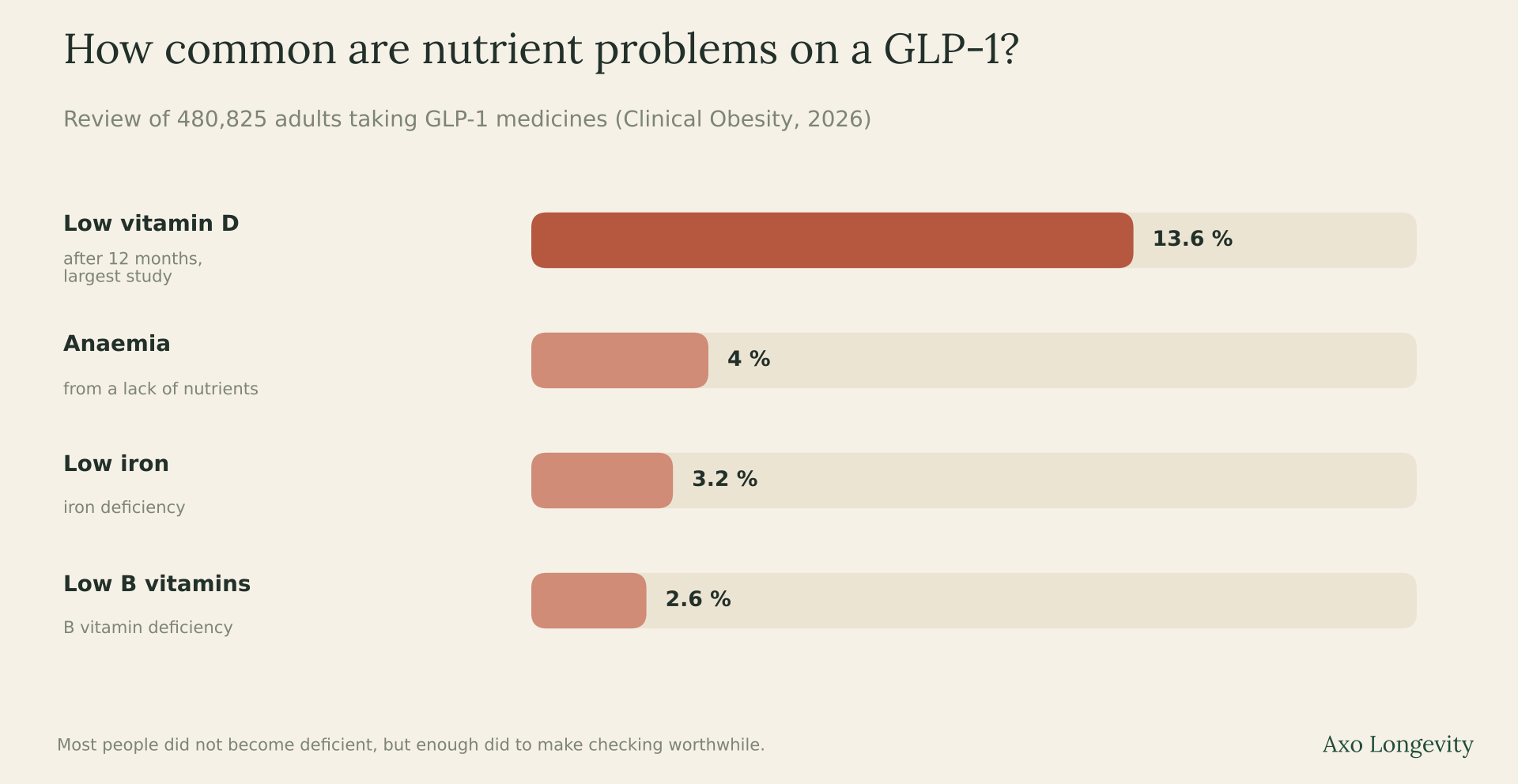
A 2026 review brought together six studies of 480,825 adults taking GLP-1 medicines for diabetes, obesity or both. Low vitamin D was the most common problem, found in 13.6% of people after 12 months of treatment in the largest study. Iron deficiency was found in 3.2%, anaemia from a lack of nutrients in 4% and low B vitamins in 2.6%. The researchers concluded that nutrient problems should be treated as a common consequence of GLP-1 treatment and checked for.
As the chart shows, most people did not become deficient. Low vitamin D affected roughly one person in seven, though, and none of these problems announces itself on the scales, which is why a blood test is the only way to know where you stand.
Muscle is the other half. In a body scan study within the Wegovy trial, people on semaglutide lost 19.3% of their fat but also 9.7% of their lean mass, which includes muscle. Because they lost more fat than lean tissue, the share of their body made up of lean mass rose by about 3 percentage points. Even so, the lean tissue you lose while eating less is worth protecting.
Which lab tests should you monitor if you are starting or taking a GLP-1?
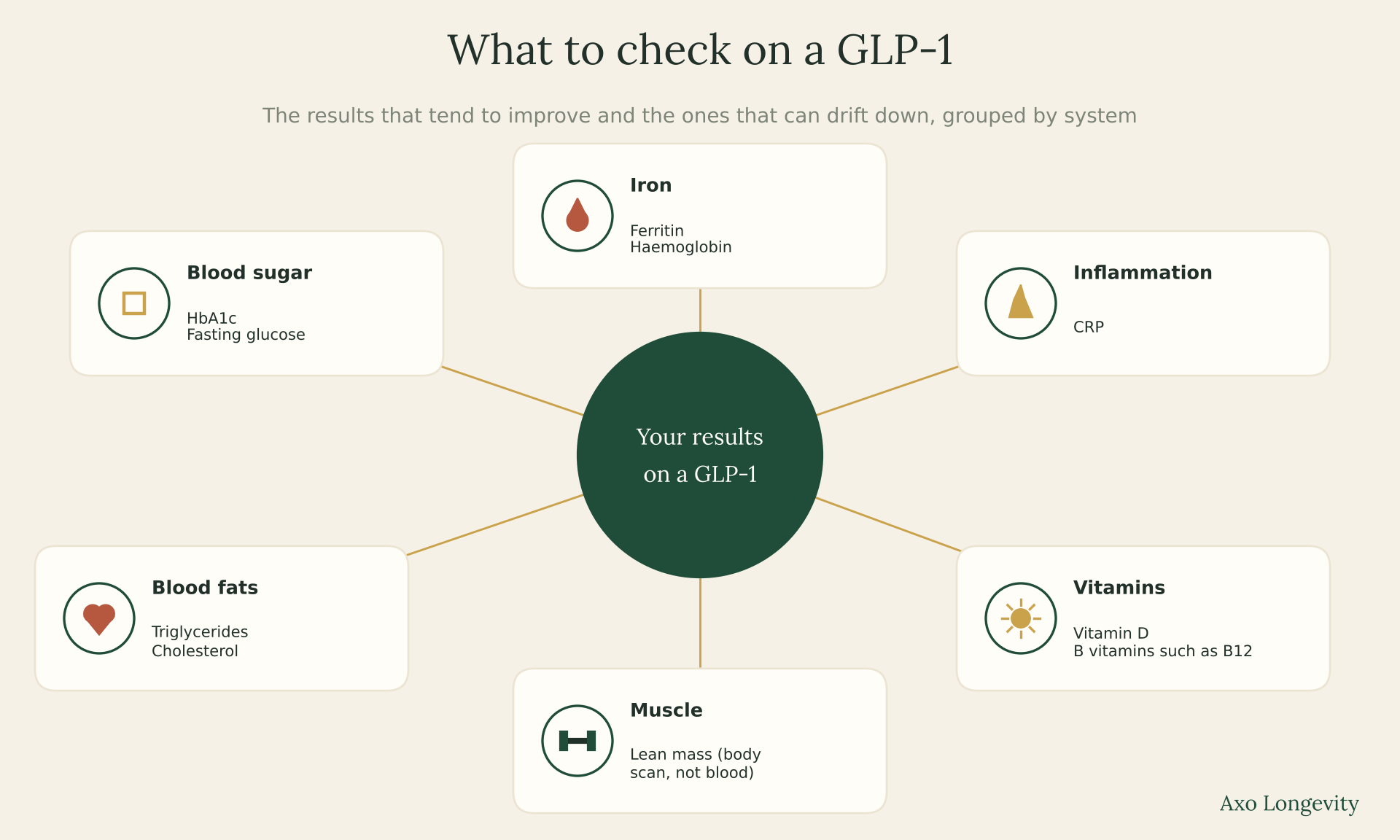
If you are thinking about a GLP-1 or already taking one, the lab tests worth monitoring cover both sides of the picture: the results you hope will improve and the ones that can drift down. Testing the same set before your first dose and again a few months in shows whether the weight you are losing is making you healthier.
As the graphic shows, they fall into six groups. Which ones matter most depends on where you are.
Thinking about starting a GLP-1? Test these first, so you have a starting point:
- Blood sugar: HbA1c, your average blood sugar over recent months, and fasting glucose
- Inflammation: CRP, which often falls as weight comes off
- Blood fats: triglycerides and cholesterol
- Vitamins: vitamin D and B12
- Iron: ferritin, your iron stores, and haemoglobin, which can show anaemia
- Muscle: lean mass, if you can have a body scan, since a blood test cannot measure it
Already taking a GLP-1? Retest a few months in, under the same conditions as your first test:
- vitamin D, B12, ferritin and haemoglobin, the results most likely to drift down
- CRP, HbA1c and blood fats, to see how far they have improved
- anything that was low or borderline at your baseline
None of these replaces the checks your prescriber arranges. They add the detail that shows how your body is coping with eating less.
Axo Longevity Care membership is built around the same before and after pattern: a baseline of 100+ lab tests, then a follow-up around six months later that repeats 50+ of them, with your results compared to optimal ranges and a personalised plan. Availability varies by country, and some lab tests are not offered in every market, so check which of the tests above are included where you live.
→ Get your baseline with Axo Longevity Care
Why test before you start a GLP-1?
A baseline test before your first dose makes every later result readable. Without it, a vitamin D level or a ferritin result taken months in is a snapshot with nothing to compare it to, and you cannot tell whether the medicine moved it or it was already low.
There is a second reason. In a 2026 study of 5,384 adults in Israel with type 2 diabetes who started semaglutide, those whose vitamin D was above 15 ng/mL (about 37 nmol/L) before starting saw a larger drop in BMI and a slightly larger drop in HbA1c after 12 months than those below it. The differences were small and the study cannot show that vitamin D caused them, but it is one more reason to know your starting point.
→ Check which blood tests need fasting before you book
What can your results look like after a year on a GLP-1?
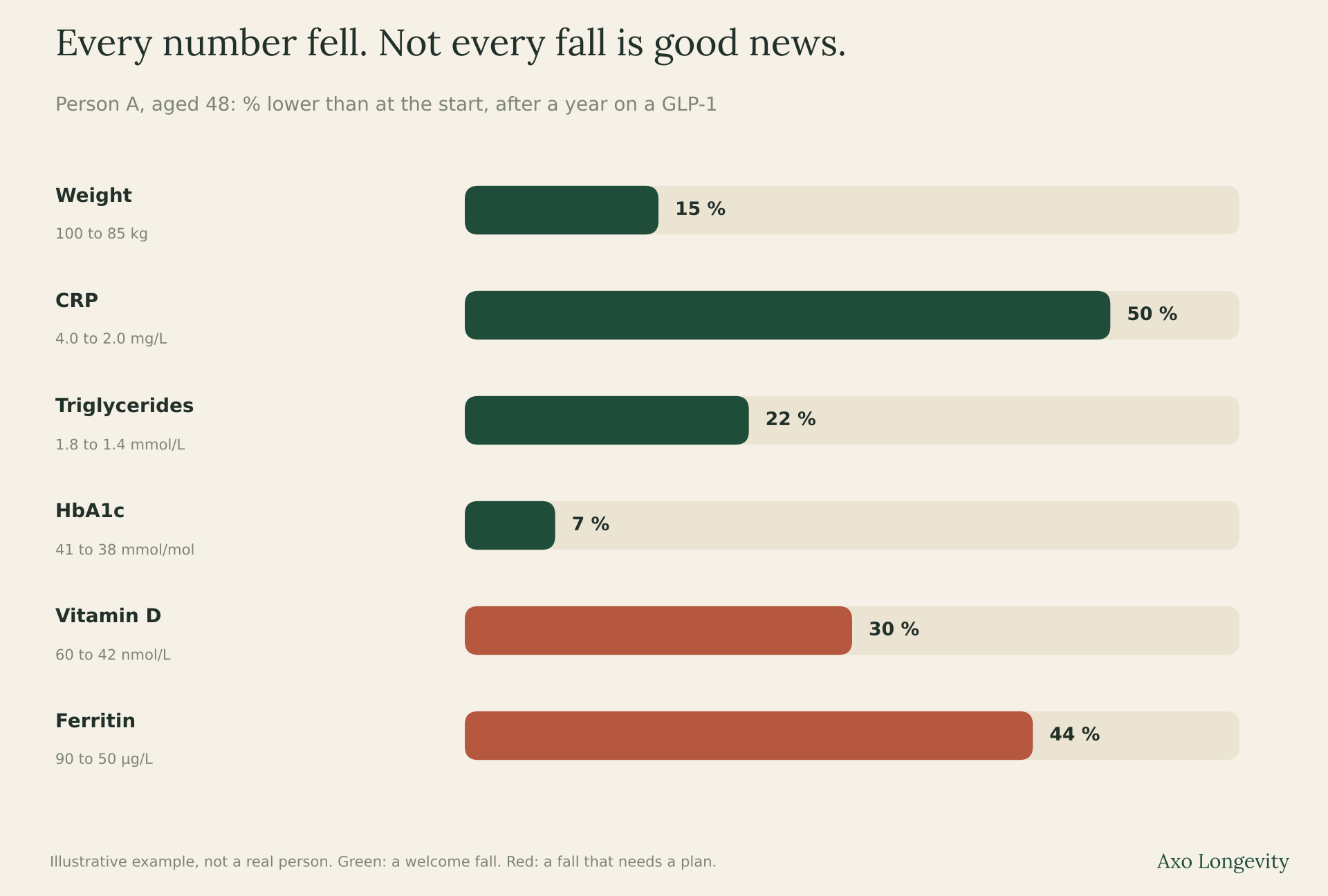
Here is how the two directions can play out in one person. Person A is 48 and starts a GLP-1 at 100 kg (an illustrative example, not a real person: the weight change is close to the trial average, and the other numbers show the kind of shifts described above).
After a year, Person A weighs 85 kg, 15% less than at the start. CRP has fallen from 4.0 to 2.0 mg/L, triglycerides from 1.8 to 1.4 mmol/L and HbA1c from 41 to 38 mmol/mol. Each of those lower numbers is good news.
Two other numbers fell as well. Vitamin D went from 60 to 42 nmol/L, and ferritin from 90 to 50 µg/L. Person A feels well and the weight keeps falling, so without a test nobody would know. On the chart, every bar shows a drop, yet the red bars are the ones that need a plan.
One thing can skew a result like this. CRP rises within hours of an infection starting, so a single high reading taken during a cold says more about the cold than about the medicine.
Before you test: if you have not started yet, book your baseline before the first dose. At every later test, mention the medicine and dose you are on, and test at a similar time of day under the same fasting conditions, so the numbers can be compared.
Do GLP-1s affect hormones like testosterone?
So far, the research suggests GLP-1 medicines do not harm male hormones, and they may raise testosterone in men with obesity. A 2026 review of five trials found no negative effect on hormones, sexual function or sperm quality.
In a 2026 analysis of 1,629 men taking GLP-1 medicines, median total testosterone rose from 320 to 419 ng/dL, about 11 to 14.5 nmol/L. The rise held after allowing for age and starting BMI, which suggests something beyond weight loss played a part. The study looked back at existing records, so it cannot prove the medicine caused the change. Men who already test their hormones will see this most clearly by comparing results from before and after starting.
How do you protect muscle and nutrients on a GLP-1?
Plan what you eat and give your muscles a reason to stay. When you eat less, each meal has to do more, and strength training tells your body the muscle is still needed.
In practice:
- include a source of protein at every meal, before the rest of the plate
- do strength training at least twice a week, with weights, machines or your own body weight
- choose foods rich in iron, vitamin D and B vitamins, such as oily fish, eggs, red meat or pulses and leafy greens
- retest the nutrients that were low or borderline at your baseline
The honest limit is that research has not yet shown the best way to protect muscle on a GLP-1. What it does show is that nutrient problems are common enough to check for. Your Axo Longevity personalised plan starts from your own results, so the changes you make target the values that are actually moving.
See your prescriber or a doctor straight away if you have severe stomach pain that spreads to your back and does not go away, as the UK medicines regulator advises. Also speak to them about:
- sickness or diarrhoea that stops you keeping fluids down, which can lead to severe dehydration
- any result flagged as low on a blood test
How often should you check your blood on a GLP-1?
Check once before you start, then again a few months in, under the same conditions each time. The baseline shows your starting point. The retest shows which results are improving and which are drifting down while you are still early enough to act. Our guide to GLP-1 medicines and heart health explains the bigger picture behind the improving numbers.
Axo Longevity measures 100+ lab tests across 36+ areas of your health. Around six months later, a follow-up repeats 50+ of those lab tests, so you can see the change for yourself.
→ Your Axo Health Score
→ Results compared to optimal ranges
→ Your personalised plan
→ A follow-up test to track the change
What else do people ask about GLP-1s and blood tests?
Can Ozempic or Wegovy change your cholesterol results?
Yes. In the main Wegovy trial, blood fats improved more with semaglutide than with placebo. A test before you start lets you see the change in your own results.
When do GLP-1 side effects start?
Stomach side effects such as nausea, vomiting and diarrhoea are the most common, and are usually mild to moderate and short-lived. In the main trial, the dose started low and rose every four weeks until week 16, and 7% of people on semaglutide stopped treatment because of side effects, against 3% on placebo.
Should you stop eating less to protect your vitamin levels?
No. Eat for nutrients rather than volume, with protein at every meal, and check your levels with a blood test. Speak to your prescriber before changing how you take the medicine.
Axo Longevity provides health information, not medical advice. Speak to a healthcare professional about your results.
Where does this information come from?
- Wilding, J. P. H., et al. (2021). Efficacy and safety of once-weekly subcutaneous semaglutide 2.4 mg in adults with overweight or obesity (STEP 1). Journal of the Endocrine Society, 5(Suppl 1), A10. https://doi.org/10.1210/jendso/bvab048.018
- Verma, S., et al. (2023). Effects of once-weekly semaglutide 2.4 mg on C-reactive protein in adults with overweight or obesity (STEP 1, 2, and 3). eClinicalMedicine, 55, 101737. https://doi.org/10.1016/j.eclinm.2022.101737
- Wiki Journal Club. STEP 1 trial summary (secondary outcomes and adverse events). https://www.wikijournalclub.org/wiki/STEP_1
- Wilding, J., et al. (2021). Impact of semaglutide on body composition in adults with overweight or obesity: analysis of the STEP 1 study. ENDO 2021 abstract. https://www.newswise.com/pdf_docs/16159288255831_Wilding%20Abstract.pdf
- Harvard Health Publishing. (2026, March 18). Study: taking GLP-1 drugs may increase risk of key nutrient deficiencies (review in Clinical Obesity, February 2026). https://www.health.harvard.edu/diet-and-nutrition/study-taking-glp-1-drugs-may-increase-risk-of-key-nutrient-deficiencies
- Israel, A., et al. (2026). Baseline vitamin D status is associated with glycemic and weight loss outcomes in patients with type 2 diabetes treated with semaglutide. Frontiers in Nutrition, 13. https://www.frontiersin.org/journals/nutrition/articles/10.3389/fnut.2026.1833045/full
- Endocrine Society. (2026, June 13). ENDO 2026: GLP-1 medicines and male reproductive health. https://www.endocrine.org/news-and-advocacy/news-room/2026/natesh-press-release-endo-2026
- MDLinx. (2026, May 13). A 1,629-patient AUA dataset links GLP-1s to testosterone gains. https://www.mdlinx.com/article/a-1-629-patient-aua-dataset-links-glp-1s-to-testosterone-gains/4ckgFDfDVKnVcMcaaswp9v
- Medicines and Healthcare products Regulatory Agency. (2026, January 29). MHRA updates guidance for GLP-1 prescribers and patients. https://www.gov.uk/government/news/mhra-updates-guidance-for-glp-1-prescribers-and-patients
- UK Government. (2026). GLP-1 medicines for weight loss and diabetes: what you need to know. https://www.gov.uk/government/publications/glp-1-medicines-for-weight-loss-and-diabetes-what-you-need-to-know/glp-1-medicines-for-weight-loss-and-diabetes-what-you-need-to-know
- Lab Tests Online UK. C-reactive protein (CRP). https://labtestsonline.org.uk/tests/c-reactive-protein
2 ways to get started
It's the best fit if you want an affordable entry point to understand your health baseline.
50+ biomarkers (one round)
Basic biomarker analysis
Biological Age and Axo Longevity Health Score
Cancel anytime
approx.
It's the best fit if you want to track trends over time rather than just see a single moment.
100+ biomarkers annually (two rounds)
Sports science protocols
Personalised health blueprint
Continuous tracking
Biological Age and Axo Longevity Health Score
Cancel anytime
approx.
150+ biomarkers annually (two rounds)
Exclusive 1:1 longevity session with Dr. Niko Mihic or Andy Walshe PhD
GlycanAge testing
Comprehensive genome testing
Annual founding member event
approx.