








Can a blood test show you are ageing faster?
October 28, 2026
TL;DR
- Biological age estimates how old your body is behaving, based on how well its systems are working, not how many birthdays you have had.
- A routine blood test can estimate it. Phenotypic age, one of the best-known measures, combines nine common blood results with your age.
- It matters because it says more about your future health than your real age, and unlike your real age, it can move.
- In a 2026 study of almost 200,000 adults under 50, people whose blood looked older than their age were more likely to develop bowel cancer, although the risk stayed small.
- One result is a snapshot. Testing again months later shows whether your habits are slowing your biological age down.
Your age is the number of birthdays you have had. It says very little about how your body is actually holding up. Two people born in the same year can be in very different places: one still recovers quickly from a hard week and has steady blood sugar, while the other is already carrying changes that usually arrive years later.
Biological age puts a number on that difference. It turns a vague feeling about how well you are ageing into something you can measure, understand and track. This guide explains what biological age is, why it is worth knowing, how a routine blood test can estimate it, and what the latest research says.
What is biological age?
Biological age is an estimate of how old your body is behaving, based on how well its systems are working rather than how long you have been alive. If it is lower than your real age, your body is showing fewer of the changes that usually come with age. If it is higher, it is showing more.
Ageing is not one event. It is a slow build-up of changes across many systems at once: how your liver makes proteins, how well your kidneys filter, how much low-level inflammation your body carries, how it handles sugar. These changes happen at different speeds in different people. Biological age adds them up into a single figure, given in years so it is easy to compare with the age on your passport.
There is no single test for it. Blood-based scores, such as phenotypic age, use routine blood results to read how your organs and systems are working right now. Epigenetic clocks, such as DunedinPACE, read chemical tags on your DNA that shift as you age, and need a specialist test. Both give the answer in years, but they measure different things, so two methods can give slightly different numbers for the same person.
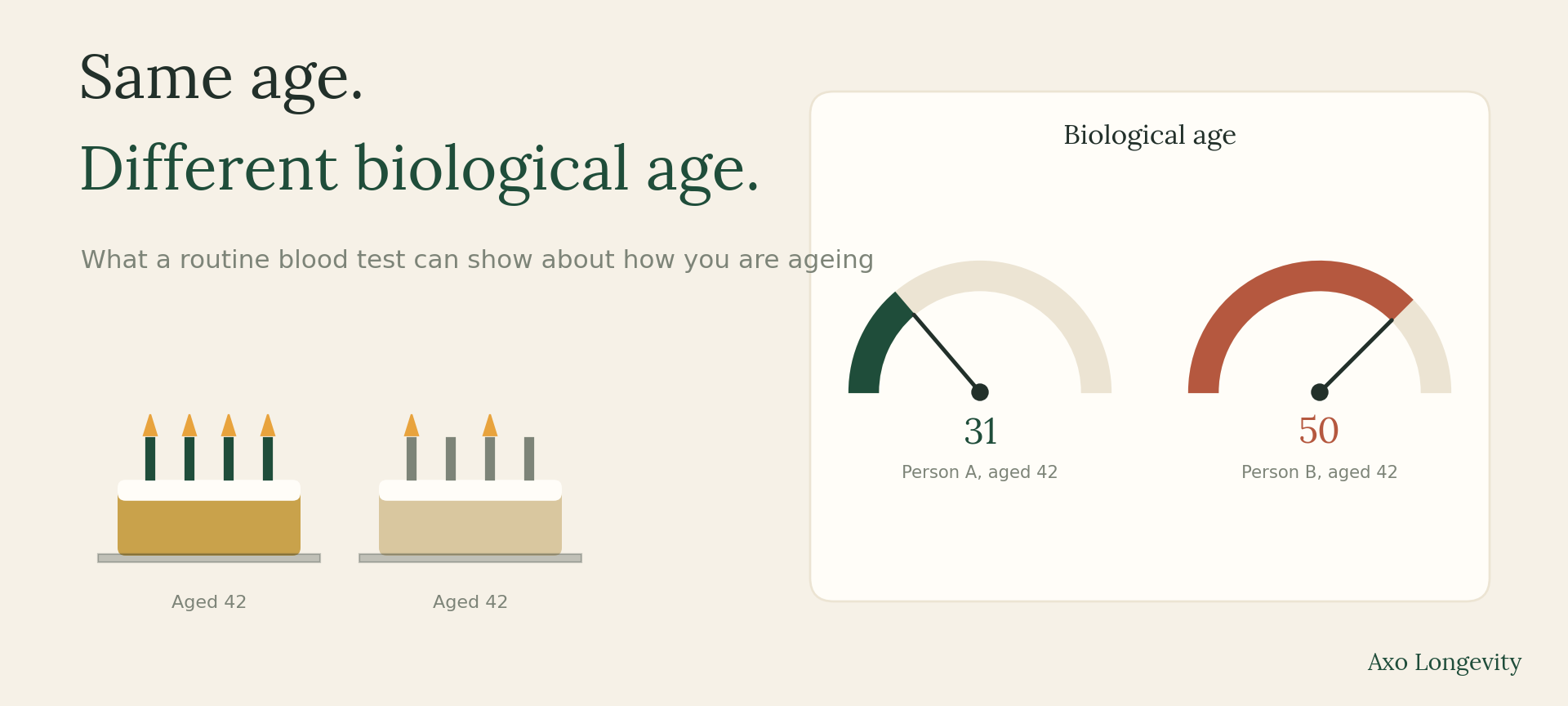
How is biological age different from your real age?
Your real age counts time. Your biological age counts wear.
Think of two cars made in the same year. One has been driven gently and serviced on time, the other has done hard miles. The year in the logbook is the same, but the condition of the engine is not. Your birth date is the logbook. Biological age is much closer to the engine.
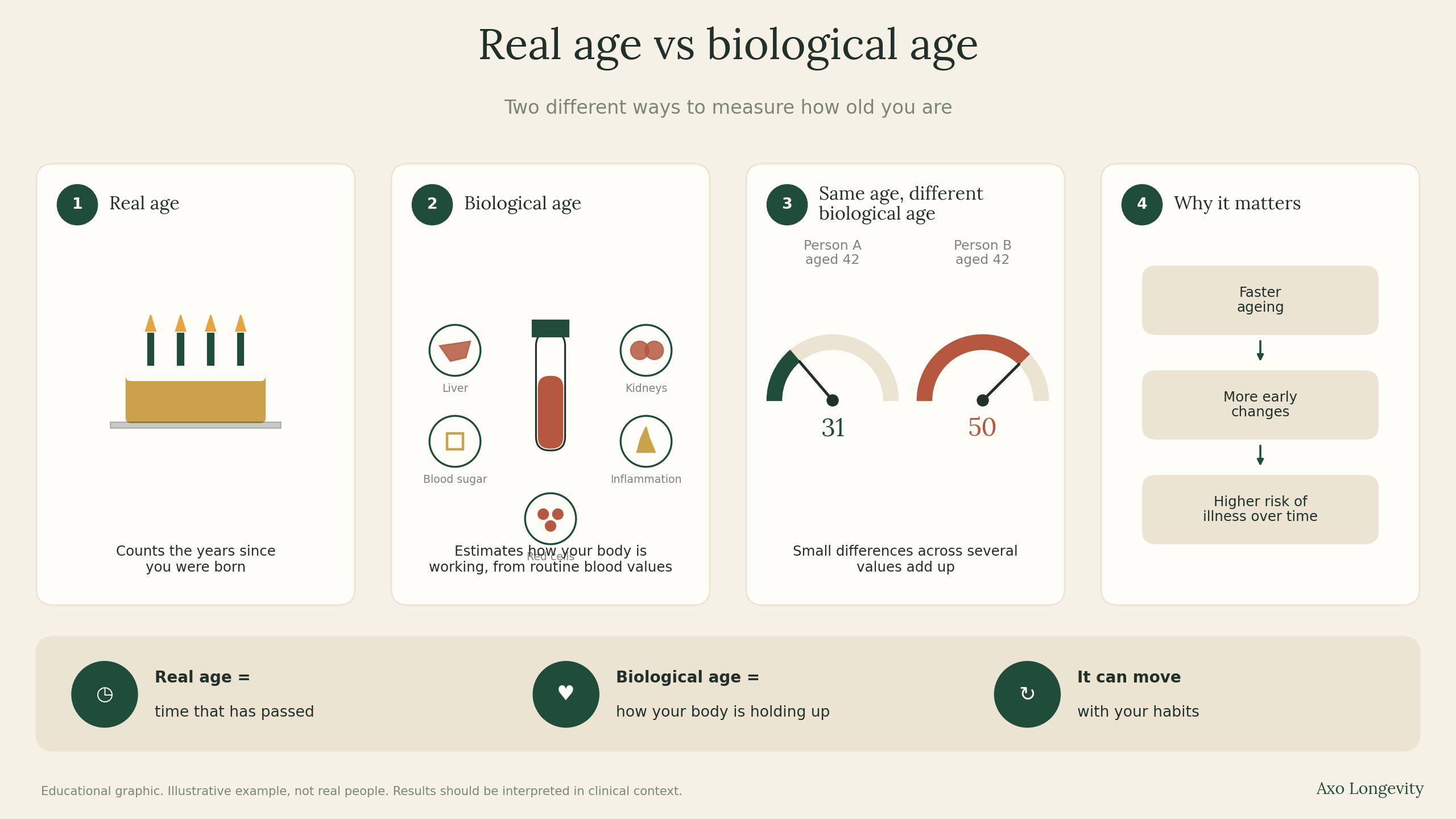
The graphic above sums it up. Your real age only tells you how much time has passed. Your biological age shows how your body is coping with that time, and two people of exactly the same age can sit years apart.
Why does biological age matter?
Biological age matters because it says more about your future health than your birthday does. Two 50-year-olds do not carry the same risk of heart disease, diabetes or other illness, and their real age cannot tell them apart. Biological age is built to do exactly that: phenotypic age was designed specifically to separate people of the same age by their risk of illness and death.
Three things make it useful rather than just interesting.
It can move. Your real age only goes one way, but your biological age responds to how you live. That makes it one of the few health numbers that can show progress.
It picks up changes early. Slightly more inflammation or slightly higher blood sugar can sit on a report without being flagged for years before it causes any symptoms. Biological age brings those small shifts together while they are still easy to act on.
It points to where to look. A blood-based score is built from separate values, so you can see which ones are pushing it up. That is why Axo Longevity reports biological age alongside your individual results: the single number shows the direction your body is heading, and the values underneath show what is driving it.
Why should you know your biological age if you feel fine?
Because feeling fine tells you how you are today, not how your body is ageing underneath. Most people only have a blood test when something feels wrong. Biological age is most useful when nothing does, because that is when small changes are easiest to turn around.
It is also a way to check whether your efforts are working. If you have changed how you train, eat or sleep, your weight and energy are only part of the picture. A biological age that holds steady or falls over a year shows the change is reaching the systems that matter for long-term health.
Which blood tests are used to calculate biological age?
Phenotypic age combines your real age with nine routine blood results. These nine were chosen from a much longer list because, together, they predicted illness and death better than age alone.
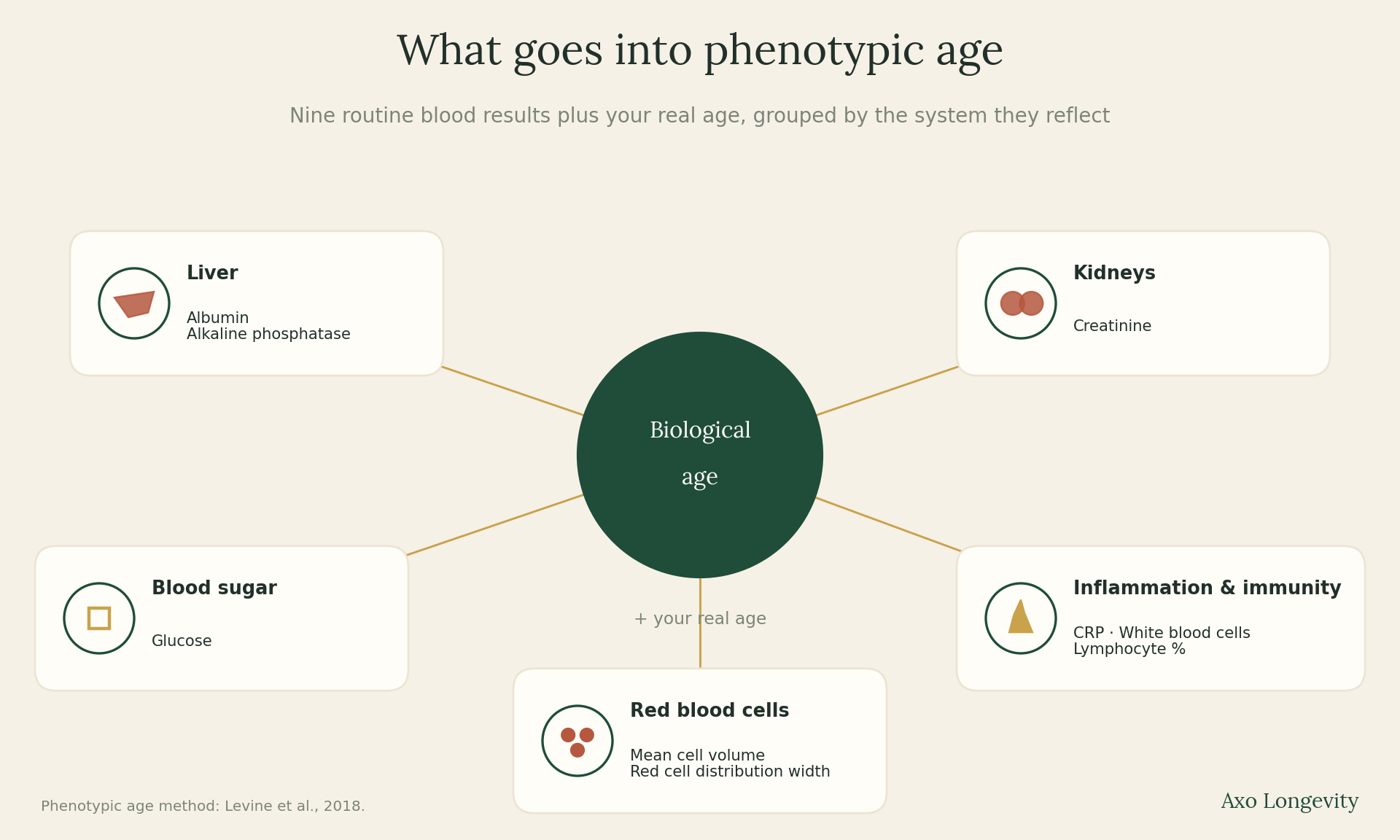
As the graphic shows, they cover five of the body's main systems:
- Liver: albumin, a protein your liver makes, and alkaline phosphatase, an enzyme from your liver and bones
- Kidneys: creatinine, a waste product your kidneys filter out
- Blood sugar: glucose
- Inflammation and immunity: CRP, which rises with inflammation, plus your white blood cell count and lymphocyte percentage
- Red blood cells: mean cell volume, the average size of your red blood cells, and red cell distribution width, how much they vary in size
None of them decides your score on its own. A higher CRP pushes biological age up, but so do a lower albumin and a wider spread in red cell size.
Why can two people of the same age have a different biological age?
Because small differences across several values add up, even when no single result stands out.
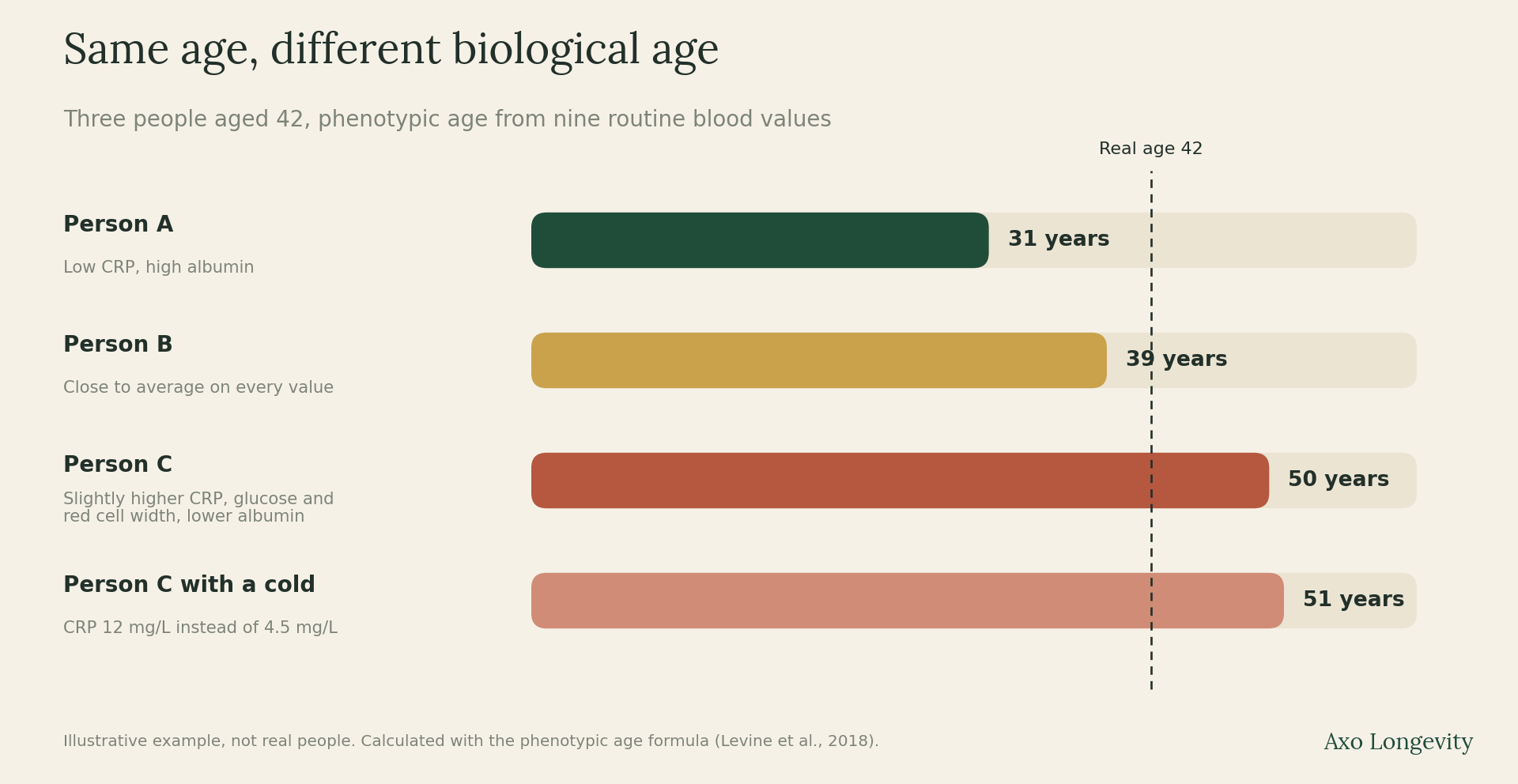
Take three people who are all 42 (an illustrative example, not real people). Person A has a low CRP of 0.6 mg/L and an albumin of 46 g/L, and comes out at a phenotypic age of 31. Person B sits close to average on every value and comes out at 39. Person C has a slightly higher CRP of 4.5 mg/L, a glucose of 5.4 mmol/L and a red cell distribution width of 14.2%, with an albumin of 39 g/L. Their phenotypic age is 50, eight years older than they are.
None of Person C's results is dramatic. The difference comes from several values all leaning the same way. That is the real strength of biological age: it notices a pattern that is easy to miss when results are read one at a time.
The last bar shows something else. Tested at the end of a cold, with a CRP of 12 mg/L, Person C's phenotypic age rises to 51, with nothing about their long-term health changing. CRP rises within hours of an infection starting, so one result can reflect one bad week.
Before you test: had a cold, flu or any infection in the last few weeks? Mention it, or move the test. Fast as your lab advises, so glucose shows your usual level, and test at a similar time of day each time.
What did the new study on biological age and bowel cancer find?
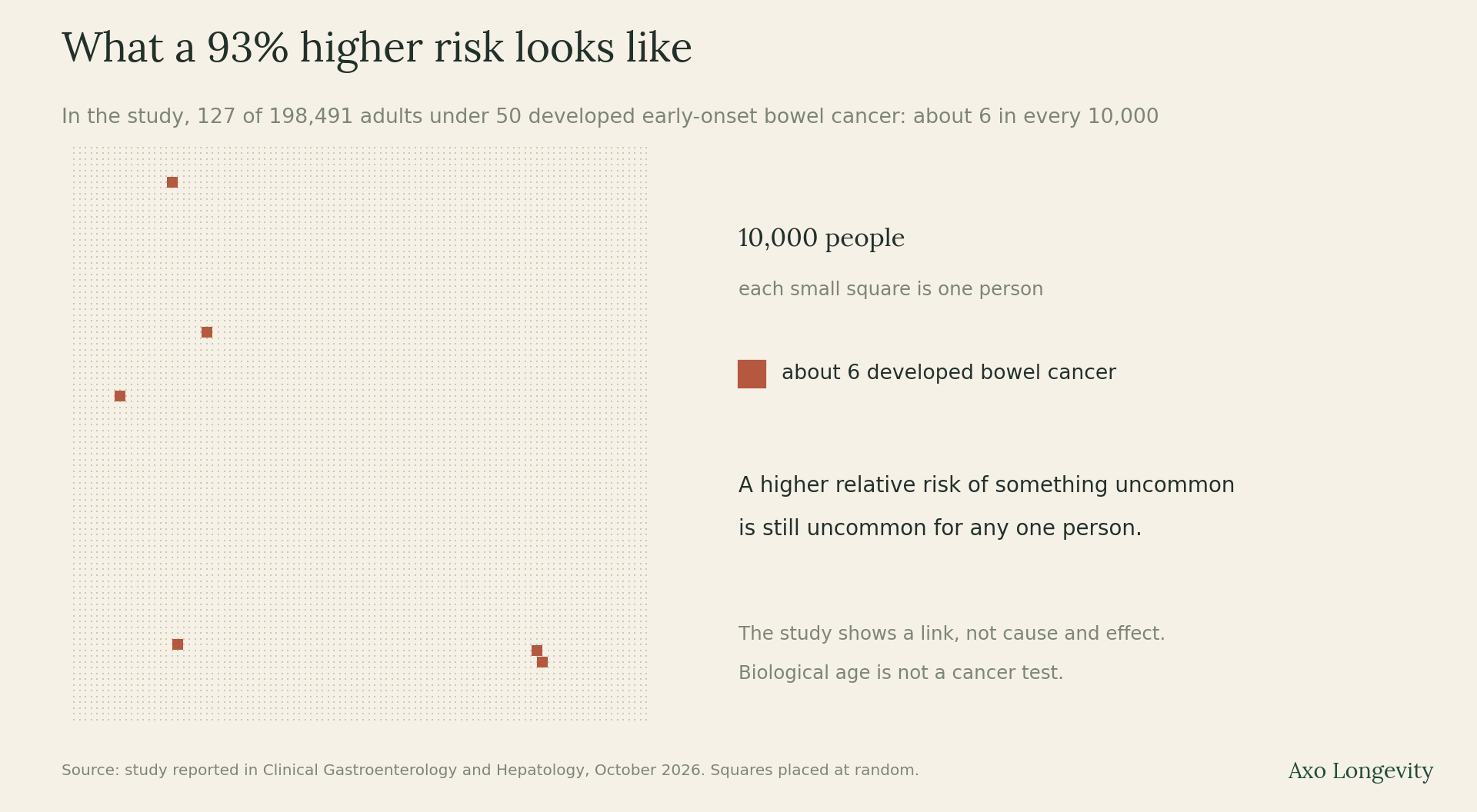
A study reported in October 2026 used phenotypic age in 198,491 adults under 50 who had health screening in South Korea between 2011 and 2021, followed for a median of 7.7 years. Each person was compared with the average for their age and placed in one of three groups. Compared with people close to the average:
- the faster-ageing group, at least two years older than average, had a 93% higher risk of early-onset bowel cancer
- each extra year of biological age added about 7% to the risk
- for cancer of the colon, the risk was more than double
- for cancer of the rectum, there was no clear link
The authors concluded that biological age from routine blood tests may help identify younger adults at higher risk, beyond what their real age alone shows.
How worried should you be about this study?
Not very, and the numbers explain why.
Across the whole study, 127 people developed early-onset bowel cancer, about 6 in every 10,000 over almost eight years. Nearly doubling a small risk still leaves a small risk, and the large majority of people in every group stayed free of it. It is also a link, not proof of cause: diet and smoking were only partly measured, and everyone in the study was Korean.
Biological age is not a cancer test. A high result does not mean you have cancer, and a normal one does not rule it out. In most of the UK, bowel cancer screening starts at 50 (60 in Northern Ireland), yet more than 2,500 people under 50 are diagnosed every year. See a doctor about any of these, whatever your age or your last blood test says:
- bleeding from your bottom or blood in your poo
- a change in your bowel habit that lasts more than four weeks
- weight loss without trying
- feeling tired a lot, or looking pale
- severe tummy pain that will not go away
What else has research found about biological age?
The Korean study is not the only one pointing the same way. A large UK study of over 300,000 people found that faster phenotypic ageing also went with a higher risk of bowel cancer, and again the link was stronger for cancer at a younger age.
A European study of around 3,300 people from eight countries measured 362 biomarkers in each person. Those who were biologically younger than their real age had a distinctly healthier blood chemistry profile, whatever their age. The researchers' conclusion matches the idea behind phenotypic age: one biomarker is not enough to describe how someone is ageing.
Can you lower your biological age?
You can move several of the values that drive it. CRP and glucose both respond to habits, and the habits linked to slower ageing are familiar ones. In a large study across several groups of people, smoking, higher body weight, raised glucose and poor blood pressure went with faster ageing, while physical activity and a healthier diet went with slower ageing.
In practice, that means:
- do not smoke
- move most days, including activity that gets you out of breath
- keep blood sugar and blood pressure in a healthy place through diet, sleep and body weight
- take part in bowel cancer screening when you are invited
What nobody can promise yet is that lowering your biological age lowers your risk of a specific disease. Treat it as a guide to how your body is ageing overall. Your Axo Longevity personalised plan starts from the values pushing your score up, so the changes you make target what matters most for you.
→ See what can move your biological age
How do you track your biological age over time?
By measuring it more than once. The same tests repeated months apart, under the same conditions, show whether your biological age is really moving and which values are moving it. Our guide to measuring inflammation explains what moves CRP, one of the values that changes most.
Axo Longevity measures 100+ lab tests across 36+ areas of your health, and your results include your biological age. Around six months later, a follow-up repeats 50+ of those lab tests, so you can see the change for yourself.
→ Your Axo Health Score
→ Your biological age
→ Results compared to optimal ranges
→ Your personalised plan
→ A follow-up test to track the change
What else do people ask about biological age?
Is biological age a real thing?
Yes, as a measurable estimate. It is not a fixed fact about you, but scores like phenotypic age predict health better than real age alone, which is what makes them meaningful.
Are biological age tests accurate?
They are estimates, and different methods can give different results for the same person. They are most useful for comparing your own results over time, tested under the same conditions.
Does a high biological age mean you have cancer?
No. It reflects inflammation, blood sugar, and liver and kidney function, which shift for many reasons. In the 2026 study, the large majority of people in every group stayed free of bowel cancer.
Axo Longevity provides health information, not medical advice. Speak to a healthcare professional about your results.
Where does this information come from?
- Levine, M. E., et al. (2018). An epigenetic biomarker of aging for lifespan and healthspan. Aging, 10(4), 573–591. https://doi.org/10.18632/aging.101414
- Medscape. (2026, October 14). Report of a study in Clinical Gastroenterology and Hepatology on biological age and early-onset colorectal cancer. https://www.medscape.com/viewarticle/faster-aging-blood-tests-tied-colorectal-cancer-risk-young-2026a10012hy
- eBioMedicine (2025). Accelerated biological ageing and colorectal cancer onset (UK Biobank). https://bb30.ndph.ox.ac.uk/ukb/pub.cgi?id=19030
- University of Konstanz. (2026, March 19). MARK-AGE biological age study. https://www.news-medical.net/news/20260319/New-method-uses-biomarkers-to-determine-a-persons-biological-age.aspx
- eBioMedicine. (2026). Epigenetic clocks: advancing biological age measures towards meaningful clinical use. https://doi.org/10.1016/j.ebiom.2026.106175
- World Cancer Research Fund. Bowel cancer signs, symptoms and screening. https://www.wcrf.org/preventing-cancer/cancer-types/bowel-cancer/signs-symptoms/
- Manchester University NHS Foundation Trust. Bowel cancer screening programme. https://mft.nhs.uk/mri/services/bowel-cancer-screening-programme
- NHS Grampian. Signs and symptoms of bowel cancer. https://www.nhsgrampian.org/globalassets/foidocument/foi-public-documents1---all-documents/bowelscreeningcardenglish.pdf
- Lab Tests Online UK. C-reactive protein (CRP). https://labtestsonline.org.uk/tests/c-reactive-protein
2 ways to get started
It's the best fit if you want an affordable entry point to understand your health baseline.
50+ biomarkers (one round)
Basic biomarker analysis
Biological Age and Axo Longevity Health Score
Cancel anytime
approx.
It's the best fit if you want to track trends over time rather than just see a single moment.
100+ biomarkers annually (two rounds)
Sports science protocols
Personalised health blueprint
Continuous tracking
Biological Age and Axo Longevity Health Score
Cancel anytime
approx.
150+ biomarkers annually (two rounds)
Exclusive 1:1 longevity session with Dr. Niko Mihic or Andy Walshe PhD
GlycanAge testing
Comprehensive genome testing
Annual founding member event
approx.