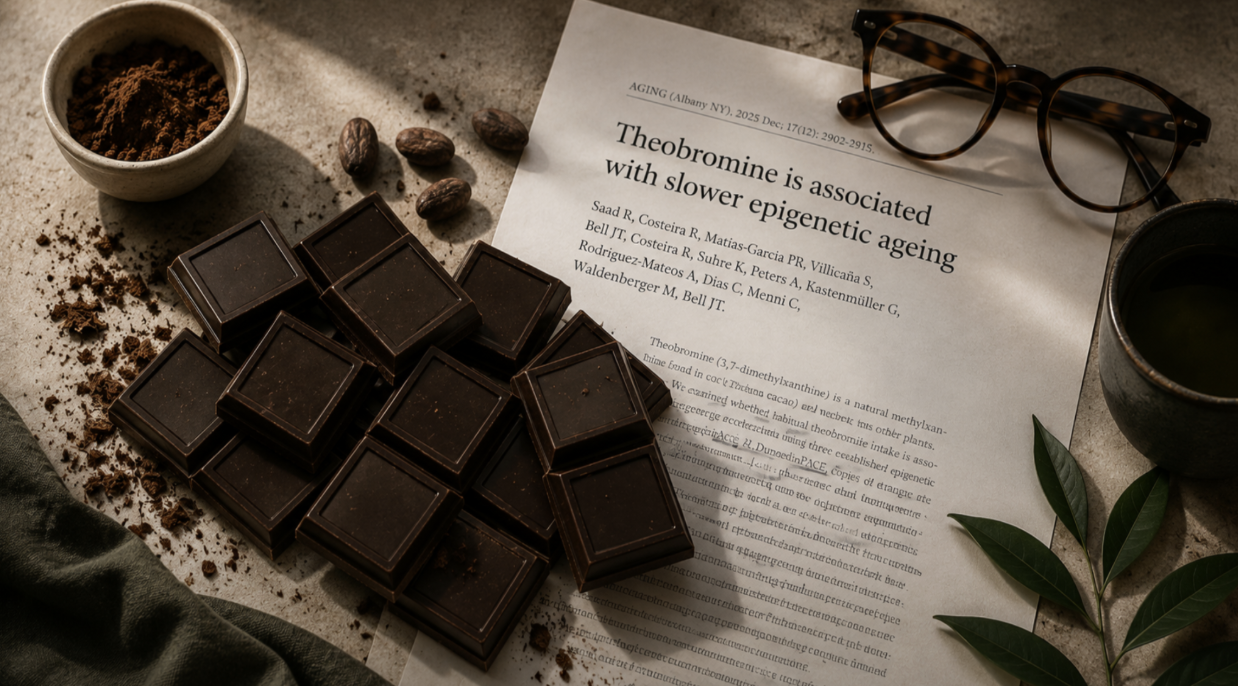
A cocoa compound called theobromine was linked to a lower biological age in nearly 1,700 adults across the UK and Germany. The finding is real and worth understanding, but it is not a reason to eat more chocolate.
A 2025 King's College London study found that people with higher levels of theobromine, a natural compound found in cocoa, tended to have a biological age slightly lower than their actual age. It was an observation across nearly 1,700 people, not proof that eating chocolate slows ageing. The link held for theobromine specifically, even after accounting for caffeine, and the effect was modest.
The takeaway is not really about chocolate. It is that your biological age can sit years away from the number on your passport, and that gap is measurable.

Researchers at King's College London, writing in the journal Aging in December 2025, looked at whether theobromine was linked to how fast people were ageing on the inside. They measured it in the blood of 1,669 adults: 509 women from the UK's TwinsUK study, with the result then replicated in 1,160 men and women from Germany's KORA study.
People with higher theobromine tended to have a biological age lower than their actual age. The team estimated ageing two ways:
Of all the cocoa and coffee compounds they checked, including caffeine, the link held only for theobromine.
Senior author Professor Jordana Bell described it as a link between a component of dark chocolate and "staying younger for longer," while making clear the study is not advice to eat more of it.
This was an association, not cause and effect. It shows that people with more theobromine in their blood tended to look biologically younger. It cannot show that the theobromine is what made the difference.
A few reasons to keep it in perspective:
The science holds up. The advice to eat more chocolate does not.
The researchers were clear that more dark chocolate is not automatically good for you, since it brings sugar and fat along with anything useful. A compound in cocoa is worth studying further, and for now, that is where it ends.
The reason this matters has little to do with chocolate and everything to do with what it measured. Biological age is an estimate of how old your body seems based on how it is working, rather than how many birthdays you have had. It is read from patterns on your DNA and markers like telomere length, and it can run ahead of or behind your actual age.
Two people born the same week can have biological ages years apart. What moves that gap is mostly within reach:
That is what makes biological age one of the most useful numbers in longevity. It turns ageing from something abstract into something you can see and, over time, move. For the full picture, see our complete guide to biological age vs chronological age.
If you enjoy good dark chocolate, this study is a small point in its favour, not a reason to change your diet:
The bigger takeaway sits under the headline.
Your biological age can differ from your real age by years, and you cannot tell which way yours is leaning from how you feel.
That gap is the difference between being in range and being optimal:
See what a full Axo panel measures
1) Does dark chocolate slow ageing?
Not as far as this study can prove. It found that people with more of a cocoa compound called theobromine in their blood tended to have a lower biological age, but this was an association rather than cause and effect. It is not evidence that eating more dark chocolate will slow how you age.
2) What is theobromine?
Theobromine is a natural compound found mainly in cocoa, and in smaller amounts in coffee. It is chemically related to caffeine but much milder as a stimulant. It has been linked to some heart benefits in earlier research, and this 2025 study connected higher blood levels to a lower biological age.
3) How much dark chocolate should I eat?
There is no amount this study supports as an anti-ageing dose. If you enjoy dark chocolate, a small amount of high-cacao, low-sugar chocolate is a reasonable choice with some benefits for blood pressure and blood vessels. It is best treated as a pleasure with upsides, not as a health intervention.
4) What is biological age?
Biological age is an estimate of how old your body seems based on how it is functioning, rather than how many years you have lived. It is measured from markers like DNA methylation patterns and telomere length, and it can be higher or lower than your actual age.
5) Can you measure your biological age?
Yes. Biological age is estimated from specific biomarkers in your blood, read against optimal ranges rather than the wide reference ranges a standard checkup uses. A comprehensive panel is designed to surface exactly these markers.