
For decades, cholesterol testing has focused on how much cholesterol is circulating inside LDL particles. ApoB measures something different.
That LDL number has become one of the most familiar measures of heart health. It appears on standard blood tests and it is often the first result people check when assessing their cardiovascular risk.
But it does not always tell the whole story.
Two people can have the same LDL cholesterol result and still carry different levels of risk. The reason lies in what LDL measures and what it leaves out, and it is why ApoB is receiving more attention in preventive and longevity medicine.
Before comparing the two, let's start by defining each one.
Cholesterol is essential. Your body needs it to:
The difficulty is that cholesterol cannot dissolve in blood. To move anywhere, it has to be packaged inside particles known as lipoproteins. LDL, or low-density lipoprotein, is the one that carries most of it.
On a standard cholesterol test, LDL is reported as LDL-C, short for LDL cholesterol. It measures the cholesterol held inside LDL particles.
It does not count the particles.
On most panels, it is not even measured. LDL-C is calculated from your total cholesterol, HDL, and triglycerides using a formula, which becomes important further down.
LDL-C has been studied for decades and remains one of the most important measures of cardiovascular risk.
The European Society of Cardiology and European Atherosclerosis Society describe LDL and other ApoB-containing lipoproteins as a direct cause of atherosclerotic cardiovascular disease, not simply a risk factor for it.
Lowering LDL-C reduces cardiovascular events accordingly: across 26 randomised trials and 170,000 participants, every 1 mmol/L reduction in LDL cholesterol cut major vascular events by 22%.
So LDL-C appears on almost every standard lipid panel, and it remains the primary target in European cholesterol guidelines.
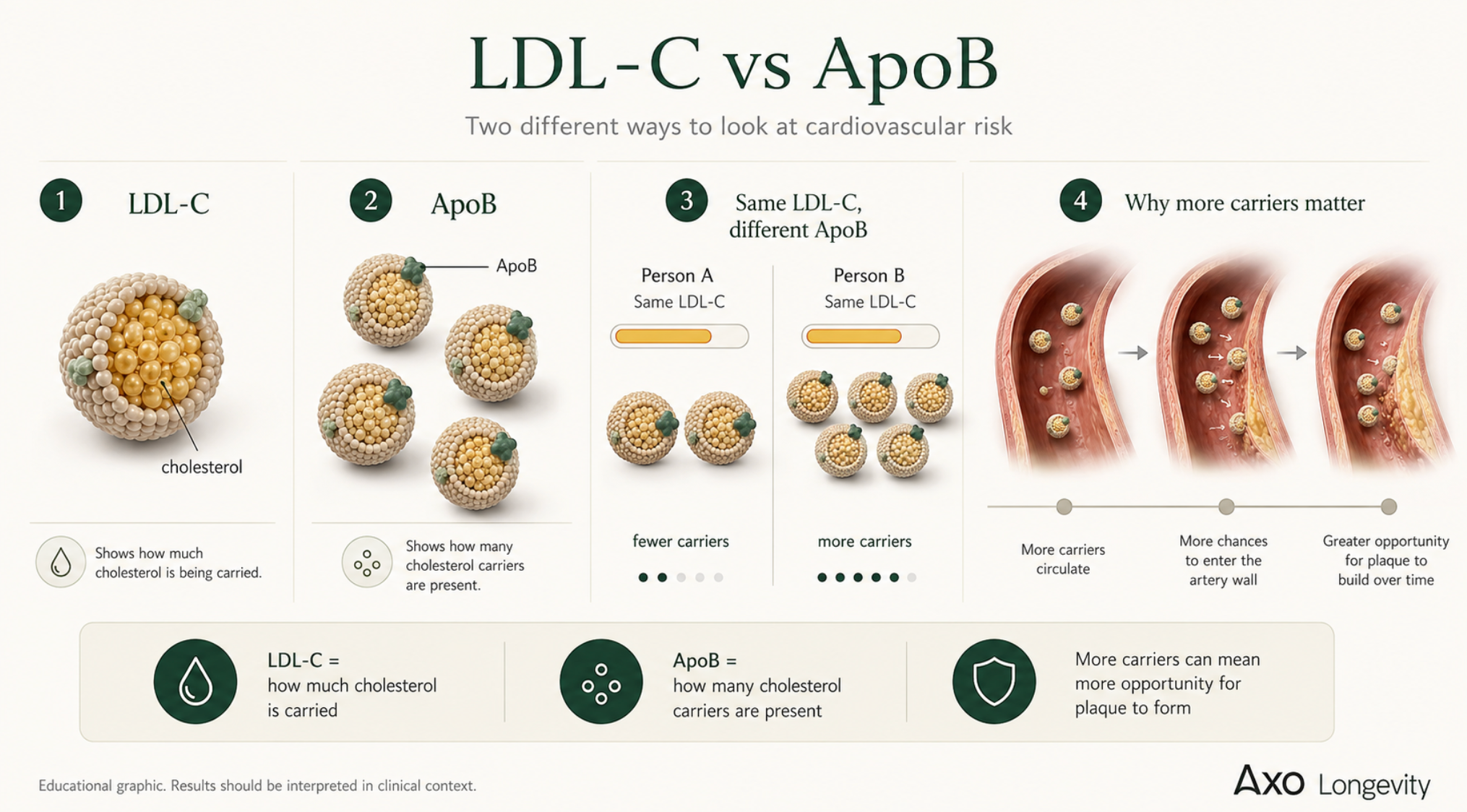
ApoB, short for apolipoprotein B, is a protein that sits on the surface of every particle capable of depositing cholesterol in an artery wall. Each of those particles carries exactly one.
That one-to-one relationship is what makes the test useful. It turns a protein measurement into a particle count.
Because plaque only forms when a particle pushes into an artery wall and lodges there. The more particles in circulation, the more often that happens.
Their size does not change that. What is packed inside them does not either.
More than LDL. Your result covers four things at once:
Most of them are LDL, which is why ApoB and LDL-C usually move together. ApoB simply counts everything.
Worth knowing about Lp(a)
Lp(a) is more damaging than a normal LDL particle of the same size, because that extra protein also encourages blood clots.
You inherit your level. It is set from childhood and barely shifts with diet or exercise, so a single measurement is usually enough for life.
Almost nobody has had one. It sits outside the standard lipid panel, so plenty of people have twenty years of normal cholesterol results and no idea about a risk they were born with. European guidelines have recommended measuring it in every adult since 2019. American guidelines caught up in 2026.
ApoB counts your Lp(a) particles in its total, but it will not tell you your Lp(a) level. That is a separate test.
Axo measures both, alongside more than 100+ other biomarkers. See what we test
Yes, and it is more common than the two tests moving together would suggest. Cholesterol content varies from particle to particle, so an LDL-C result that looks reassuring can be produced by a modest number of well-filled particles or by a much larger number of half-empty ones.
Two people get their results back. Both have an LDL-C of 2.6 mmol/L. Neither is told anything further.
The first is carrying that cholesterol in fewer, fuller particles. The second is carrying the same total spread across many more, each holding less.
Only the second person has a raised particle count, and nothing on either report would reveal it.
In a 2024 analysis of 293,876 UK adults with no history of cardiovascular disease, people who all shared that same LDL-C result had ApoB values spread from 0.68 to 0.87 g/L.
Reading that range
Because every particle carries one ApoB molecule, those figures are particle counts.
Someone at 0.87 g/L is carrying roughly a quarter more particles than someone at 0.68 g/L. Both received an identical cholesterol result.
The gap is not spread evenly across the population. It opens widest wherever the liver is producing more particles than average, which points to a familiar cluster:
What these groups have in common is that their cholesterol results usually come back acceptable. The particle count is the part nobody looked at.
ApoB is included as standard in every Axo panel, alongside Lp(a).
Both sit within more than 100+ lab tests covering 36+ health areas, so the particle count arrives with the lipid and metabolic biomarkers that give it context.
Explore the Axo Longevity care membership
1) Does ApoB replace a cholesterol test?
No. LDL-C remains the primary treatment target in European guidelines and carries decades of trial evidence behind it. ApoB adds a second dimension by counting particles rather than weighing their contents. The two are most useful read together.
2) What is a good ApoB level?
There is no single figure, because targets depend on your overall cardiovascular risk rather than on the number by itself. European and American guidelines set different thresholds for different risk categories. Your result becomes meaningful alongside your age, family history, blood pressure and metabolic biomarkers.
3) Can you lower ApoB?
Yes. Particle counts respond to the same things that move cholesterol, and often more visibly, because what changes is how many particles your liver puts into circulation. We cover diet, training, weight and medication in a separate guide
4) Is ApoB the same as LDL particle number?
Almost, but not quite. LDL particle number counts LDL particles only. ApoB counts every particle capable of entering an artery wall, which includes VLDL, remnants and Lp(a) alongside LDL. Because most of those particles are LDL in most people, the two measurements usually sit close together.
5) How often should ApoB be retested?
It depends on what has changed. After a shift in diet, training, weight or medication, three months is generally long enough for a new result to be meaningful. Where nothing has changed, annual testing is enough to establish a trend. Lp(a) is the exception, since your level stays fixed and rarely needs repeating.
This article is for educational purposes and does not constitute medical advice. Speak to a qualified clinician about your own results, and before making any change to prescribed treatment.